




U.S. MARKETS: GENERAL PRESS COMMENTARY
Stocks moved sharply lower over the course of the trading day on Tuesday, more than offsetting the moderate rebound seen during Monday’s session. The major averages all showed significant moves to the downside, falling to their lowest closing levels in over three months.
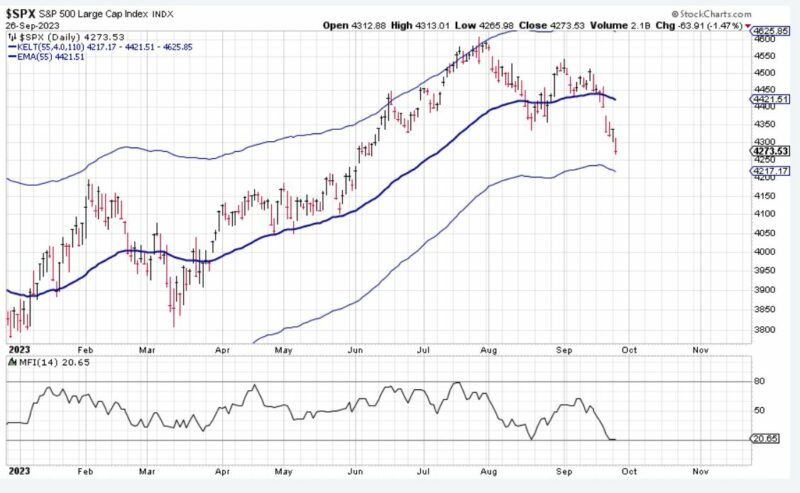
The major averages climbed off their worst levels going into the close but still posted steep losses. The Dow slumped 388.00 points or 1.1 percent to 33,618.88, the Nasdaq plunged 207.71 points or 1.6 percent to 13,063.61 and the S&P 500 tumbled 63.91 points or 1.5 percent to 4,273.53.
The sell-off on Wall Street came amid ongoing concerns about the outlook for interest rates, with JPMorgan Chase (JPM) CEO Jamie Dimon warning in an interview with The Times of India that rates could go as high as 7 percent.
“I am not sure if the world is prepared for 7%,” Dimon said. “I ask people in business, ‘Are you prepared for something like 7%?’ The worst case is 7% with stagflation.”
“If they are going to have lower volumes and higher rates, there will be stress in the system,” he added. “We urge our clients to be prepared for that kind of stress.”
Minneapolis Federal Reserve President Neel Kashkari also wrote in an essay posted on Tuesday that there is a 40 percent chance the Federal Reserve will have to push rates “meaningfully higher” to combat stubborn services inflation.
Last week, the Fed left interest rates unchanged as widely expected but forecast another rate hike before the end of the year as well as keeping rates at elevated levels for longer than previously anticipated.
Worries about the economic outlook also weighed on Wall Street following the release of separate reports showing a sharp pullback in new home sales and a significant deterioration in consumer confidence.
The Commerce Department released a report showing new home sales plummeted by 8.7 percent to an annual rate of 675,000 in August after soaring by 8.0 percent to an upwardly revised rate of 739,000 in July.
Economists had expected new home sales to decrease to an annual rate of 700,000 from the 714,000 originally reported for the previous month.
With the upward revision, the annual rate of new home sales in July was the highest since hitting 773,000 in February 2022.
A separate report released by the Conference Board showed its consumer confidence index tumbled to 103.0 in September from an upwardly revised 108.7 in August.
Economists had expected the consumer confidence index to edge down to 105.8 from the 106.1 originally reported for the previous month.
“Write-in responses showed that consumers continued to be preoccupied with rising prices in general, and for groceries and gasoline in particular,” said Dana Peterson, Chief Economist at The Conference Board. “Consumers also expressed concerns about the political situation and higher interest rates.”
Gold stocks moved sharply lower over the course of the session, dragging the NYSE Arca Gold Bugs Index down by 3.0 percent to its lowest closing level in over six months.
The weakness among gold stocks came amid a decrease by the price of the precious metal, with gold for December delivery falling $16.80 to $1,919.80 an ounce.
Significant weakness was also visible among interest rate-sensitive utilities stocks, resulting in a 2.9 percent nosedive by the Dow Jones Utility Average.
Retail stocks also saw considerable weakness on the day, as reflected by the 2.3 percent drop by the Dow Jones U.S. Retail Index. The index fell to a new three-month closing low.
Networking, transportation and commercial real estate stocks also showed notable moves to the downside amid broad based selling pressure on Wall Street.
Other Markets
In overseas trading, stock markets across the Asia-Pacific region moved mostly lower during trading on Tuesday. Japan’s Nikkei 225 Index slumped by 1.1 percent, while Hong Kong’s Hang Seng Index tumbled by 1.5 percent.
Most European stocks also moved to the downside on the day. While the German DAX Index slumped by 1.0 percent and the French CAC 40 Index slid by 0.7 percent, the U.K.’s FTSE 100 Index bucked the downtrend and closed just above the unchanged line.
In the bond market, treasuries showed a significant downturn after seeing early strength. As a result, the yield on the benchmark ten-year note, which moves opposite of its price, inched up 1.6 basis points to a nearly sixteen-year high of 4.558 percent after hitting a low of 4.483 percent.
Looking Ahead
A report on durable goods orders is likely to attract some attention on Wednesday, although trading activity may be subdued ahead of the release of key inflation data later in the week.

Mark Leibovit: Value of US Dollar Tied to Interest Rates
https://tinyurl.com/bdejpjuv
NEXT UPDATE THURSDAY EVENING
SPX – WEEKLY – BULLS ON THE RUN HERE AS FORECAST
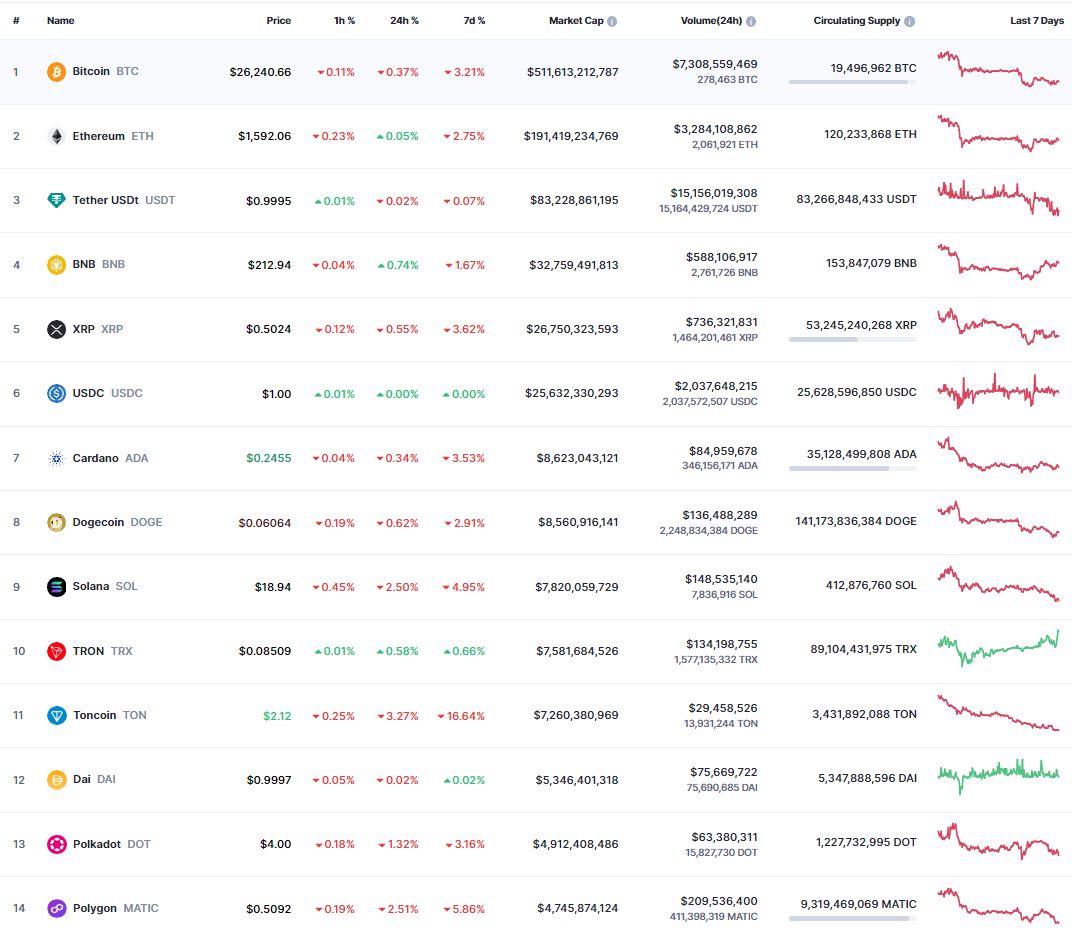
CRYPTO UPDATE AS OF SEPTEMBER 26:
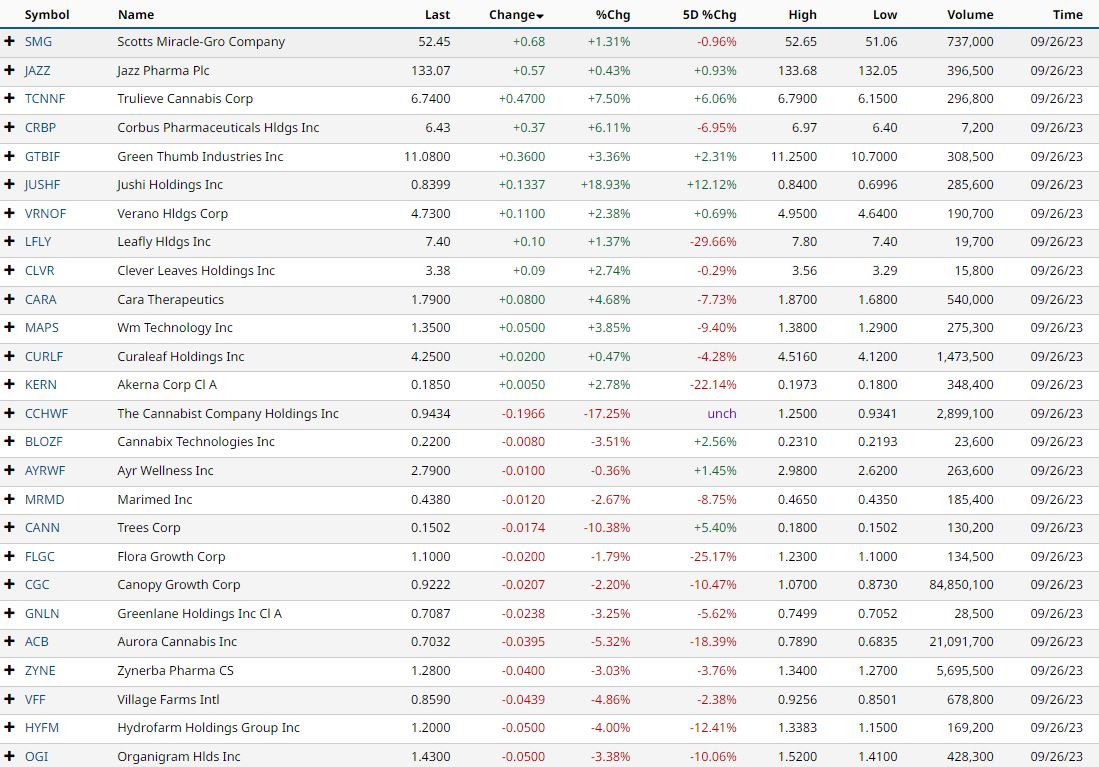
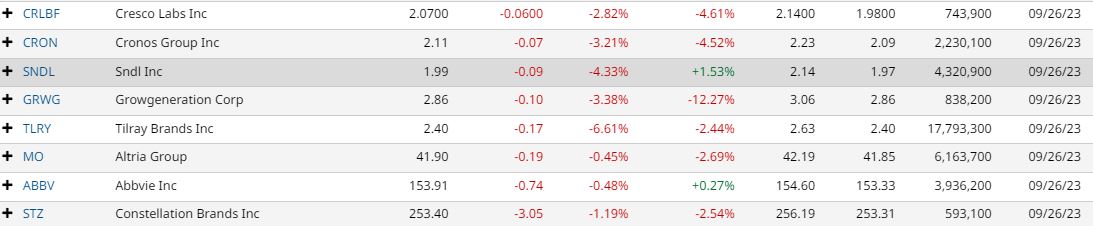
CANNABIS MOVERS AND SHAKERS SEPTEMBER 26:


The SEC is Snooping on All Your Trades
EDITOR’S NOTE: The War on Cash is fought on a variety of fronts but the end result is always a loss of liberty and privacy for us all. The SEC’s sharing of the data on every market move we make is just the latest strategy. While the tracking should be alarming in and of itself, the threat of this information being open to hacking is of even greater concern. A centralized database to track every American investor is, without question, an unconstitutional data grab; but can it be stopped?
What’s in Your Portfolio? The SEC is Snooping on All Your Trades -MishTalk.com
portfolioThe SEC is now tracking your stock trades by your Social Security Number. It shares the data with 3,000 outside agencies.
In 2012 the SEC approved a new rule requiring a Consolidated Audit Trail to Monitor and Analyze Trading Activity.
“A consolidated audit trail that accurately tracks orders throughout their lifecycle and identifies the broker-dealers handling them will provide us with an unprecedented ability to effectively oversee the markets we regulate,” said SEC Chairman Mary Schapiro.
The new rule becomes effective 60 days after its publication in the Federal Register. SROs are required to submit the NMS plan to the Commission within 270 days of the rule’s publication in the Federal Register. Once the Commission approves the NMS plan, the SROs are required to report the required data to the central repository within one year, and members of the SROs are required to report within two years. Certain small broker-dealers will have up to three years to report the data.
This ruling was in response to a 2010 flash crash and quietly sat for years. The SEC is now following through.
The scope of the Consolidated Audit Trail, or CAT, a regulation the SEC issued in 2016 but implemented only recently, is breathtaking and unprecedented. In the words of the SEC press release, the regulation instructs regulated financial institutions to identify “every order, cancellation, modification and trade execution for all exchange-listed equities and options across all U.S. markets.”
Government Shutdown Could Push Unemployment To 4%, Triggering Recession Start Signal -ZeroHedge

by Tyler Durden
According to Bloomberg chief economist Anna Wong, online betting markets see a 69% chance of a federal government shutdown starting Oct. 1, when appropriations will lapse if lawmakers can’t agree on a funding bill (in reality, the odds of a shutdown are just about 100%, although after a few weeks all should go back to normal as it always does after people get bored with the theatrics).
According to Goldman, a government-wide shutdown would reduce quarterly annualized growth by around 0.2% for each week it lasted after accounting for modest private sector effects. Goldman’s baseline is that a shutdown could last for 2-3 weeks (the Trump government shutdown, the longest in history, lasted 35 days, from Dec 22, 2018 to Jan 25, 2019).
Meanwhile, Bloomberg Economics estimates a month-long government shutdown could temporarily push up the unemployment rate in October, triggering a popular rule for identifying the start of a recession.
And while the hit to unemployment and GDP growth will reverse once the funding impasse is resolved, Bloomberg’s baseline is for the shutdown to have a mild negative impact overall due to forgone economic activity and uncertainty.
Bloomberg also speculates that in an extreme tail event, the maximum hit to 4Q GDP would be a drag of 2.8% if the shutdown lasts for the entire quarter.
Considering that the current Bloomberg survey median sees just 0.4% GDP growth for 4Q, a shutdown that lasts all quarter would push 4Q growth deep into negative territory, something we first said on Tuesday. However, as noted above, past shutdowns have, on average, been much shorter. The eight government shutdowns since 1982 have lasted an average of two weeks. The longest one — in 2018 — lasted five weeks.
Assuming a two-week duration, the shutdown will knock 0.5% off annualized quarterly GDP growth while it’s ongoing, and raise the unemployment rate by 0.1% in October. The effects will mostly reverse within 4Q once the funding stalemate is resolved, but forgone economic activity and the uncertainty from the shock could produce a net drag of 0.1% on 4Q GDP.
In the scenario of a month-long shutdown — and assuming the unemployment rate remains at 3.8% in September — October’s unemployment rate could increase to 4.0%. That would meet the Sahm Rule threshold for identifying a recession.
‘Bond King’ Jeffrey Gundlach warns of ‘demons on the horizon’ for stocks – and predicts a dollar disaster and recession next year -Yahoo! Finance

by Theron Mohamed
Jeffrey Gundlach issued a slew of warnings about the stock market, the US dollar, and an upcoming recession during the Future Proof conference last week.
The S&P 500 and Nasdaq Composite have surged 16% and 31% respectively this year, as investors price in the potential boost to companies from artificial intelligence and future cuts to interest rates. However, they’re overlooking “demons on the horizon,” Gundlach cautioned.
The billionaire CEO of DoubleLine Capital highlighted signs of a faltering US economy as a key concern. He pointed to a recent wave of corporate layoffs, and consumers feeling the squeeze from record amounts of credit-card debt as red flags. He also noted the chilling effect of higher mortgage rates on the housing market, and the challenge for small businesses of having to refinance their debts at much higher interest rates.
“The economy is definitely weakening,” Gundlach said. “I look for one next year, and I think the indicators are getting really convincing in that regard,” he said about the prospect of a recession.
The fund manager — whose nickname is the “Bond King” — also argued that economic growth has been shored up this year by a dangerous and unsustainable amount of government spending.
“The economy is only growing because we have a budget deficit that is 8% of GDP,” he said. “It’s about the same today as the depths of the global financial crisis.”
Gundlach underscored that the federal government financed most of its spending at rock-bottom rates. However, the Federal Reserve’s war on inflation has seen it hike rates from nearly zero to over 5% since last spring, meaning the government’s interest charges on trillions of dollars of debt are poised to balloon.


https://tinyurl.com/2rd9wv52
OPPORTUNITY TO ACCESS MARK LEIBOVIT’S PROPRIETARY VOLUME REVERSAL INDICATOR – THIS IS THE ONLY PLACE TO DO IT!
https://www.metastock.com/
COME ON, DAD. IT’S TIME TO EAT

DISCLAIMER:
WE ARE NOT FINANCIAL ADVISORS AND DO NOT PROVIDE FINANCIAL ADVICE
The website, LeibovitVRNewsletters.com, is published by LeibovitVRNewsletters LLC.
In using LeibovitVRnewsletters.com (a/k/a LeibovitVRNewsletters LLC) you agree to these Terms & Conditions governing the use of the service. These Terms & Conditions are subject to change without notice. We are publishers and are not registered as a broker-dealer or investment adviser either with the U.S. Securities and Exchange Commission or with any state securities authority.
All stocks and ETFs discussed are HYPOTHETICAL and not actual trades whose actual execution may differ markedly from prices posted on the website and in emails. This may be due internet connectivity, quote delays, data entry errors and other market conditions. Hypothetical or simulated performance results have certain inherent limitations as to liquidity and execution among other variables. PAST RESULTS ARE NOT NECESSARILY INDICATIVE OF FUTURE FORECASTING ACCURACY OR PROFITABLE TRADING RESULTS.
All investments are subject to risk, which should be considered on an individual basis before making any investment decision. We are not responsible for errors and omissions. These publications are intended solely for information and educational purposes only and the content within is not to be construed, under any circumstances, as an offer to buy or to sell or a solicitation to buy or sell or trade in any commodities or securities named within.
All commentary is provided for educational purposes only. This material is based upon information we consider reliable. However, accuracy is not guaranteed. Subscribers should always do their own investigation before investing in any security. Furthermore, you cannot be assured that your will profit or that any losses can or will be limited. It is important to know that no guarantee of any kind is implied nor possible where projections of future conditions in the markets are attempted.
Stocks and ETFs may be held by principals of LeibovitVRNewsletters LLC whose personal investment decisions including entry and exit points may differ from guidelines posted.
LeibovitVRNewsletters.com cannot and do not assess, verify or guarantee the suitability or profitability of any particular investment. You bear responsibility for your own investment research and decisions and should seek the advice of a qualified securities professional before making any investment. As an express condition of using this service and anytime after ending the service, you agree not to hold LeibovitVRNewsletters.com or any employees liable for trading losses, lost profits or other damages resulting from your use of information on the Site in any form (Web-based, email-based, or downloadable software), and you agree to indemnify and hold LeibovitVRNewsletters.com and its employees harmless from and against any and all claims, losses, liabilities, costs, and expenses (including but not limited to attorneys’ fees) arising from your violation of this agreement. This paragraph is not intended to limit rights available to you or to us that may be available under the federal securities laws.
For rights, permissions, subscription and customer service, contact the publisher at mark.vrtrader@gmail.com or call at 928-282-1275 or mail to 10632 N. Scottsdale Road B-426, Scottsdale, AZ 85254.
The Leibovit Volume Reversal, Volume Reversal and Leibovit VR are registered trademarks.
© Copyright 2023. All rights reserved.
[/fusion_text][/fusion_builder_column][/fusion_builder_row][/fusion_builder_container]