




U.S. MARKETS: GENERAL COMMENTARY
With traders continuing to express concerns about the outlook for interest rates, stocks moved sharply lower over the course of the trading day on Tuesday. The major averages all showed substantial moves to the downside after ending Monday’s trading mixed.
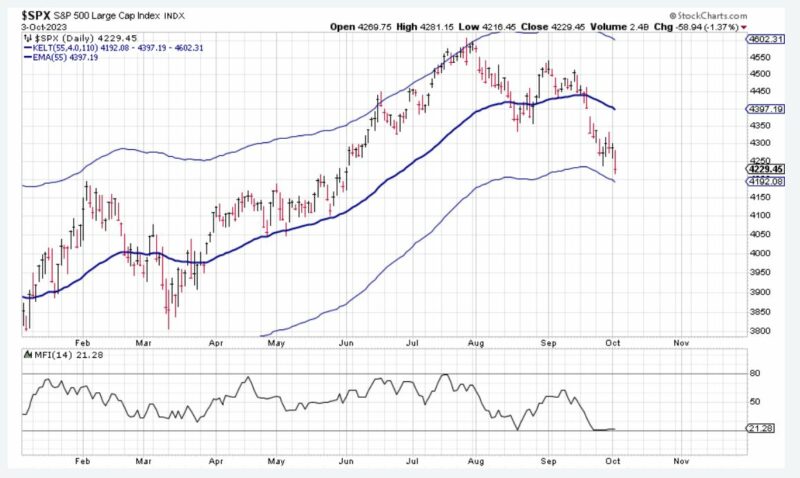
The major averages climbed off their worst levels going into the close but still posted steep losses. The Dow slumped 430.97 points or 1.3 percent to 33,002.38, the Nasdaq plunged 248.31 points or 1.9 percent to 13,059.47 and the S&P 500 tumbled 58.94 points or 1.4 percent to 4,229.45.
With the significant decreases on the day, the major averages all ended the session at their lowest closing levels in four months.
The sell-off on Wall Street came following the release of a report from the Labor Department unexpectedly showing a notable increase in U.S. job openings in the month of August.
The Labor Department said job openings surged to 9.61 million in August from an upwardly revised 8.92 million in July.
The jump surprised economists, who had expected job openings to edge down to 8.80 million from the 8.83 million originally reported for the previous month.
The data added to interest rate concerns amid worries strength in the labor market could convince the Federal Reserve to raise rates higher than had been anticipated and keep rates an elevated level for longer than expected.
“While the value of the JOLTS data has been called into question, the Fed continues to monitor it as a gauge the of labor market conditions and on the surface, it’s telling us that labor market conditions remain tight,” said Nancy Vanden Houten, U.S. Lead Economist at Oxford Economics.
She added, “The Fed won’t make policy decisions based on one JOLTS report, but it does keep the risks tilted toward another rate hike.”
CME Group’s FedWatch Tool is currently indicating a 27.7 percent chance the Fed will raise rates by another quarter point next month and a 39.2 percent chance of a quarter point rate hike in December.
The interest rate worries contributed to a continued surge by treasury yields, with the yield on the benchmark ten-year note jumping to its highest levels in sixteen years.
Key economic data due to be released in the coming days, including the closely watched monthly jobs report, could have a significant impact on the outlook for rates.
Airline stocks saw substantial weakness on the day, resulting in a 2.8 percent nosedive by the NYSE Arca Airline Index. The index plummeted to its lowest closing level in nine months.
Significant weakness was also visible among software stocks, as reflected by the 2.6 percent plunge by the Dow Jones U.S. Software Index.
Interest rate concerns also weighed on housing stocks, dragging the Philadelphia Housing Sector Index down by 2.5 percent to a nearly four-month closing low.
Networking, financial and retail stocks also saw considerable weakness on the day, while some strength emerged among utilities stocks.
Other Markets
In overseas trading, stock markets across the Asia-Pacific region moved mostly lower during trading on Tuesday. Japan’s Nikkei 225 Index tumbled by 1.6 percent, while Hong Kong’s Hang Seng Index plunged by 2.7 percent.
The major European markets also moved to the downside on the day. While the U.K.’s FTSE 100 Index fell by 0.5 percent, the French CAC 40 Index and the German DAX Index slumped by 1.0 percent and 1.1 percent, respectively.
In the bond market, treasuries extended the sharp pullback seen in the previous session. As a result, the yield on the benchmark ten-year note, which moves opposite of its price, spiked 11.9 basis points to 4.802 percent.
Looking Ahead
Reports on private sector employment, service sector activity and factory orders may attract attention on Wednesday along with remarks by several Fed officials.
SPX TRYING TO BOUNCE BUT NEGATIVE CYCLICAL FORCES MAY SPOIL THE PLANS

Mark Leibovit: How to Protect Investments With Unpredictable US Government – Sept. 28, 2023
https://tinyurl.com/muynvd3v
NEXT PODCAST THURSDAY EVENING
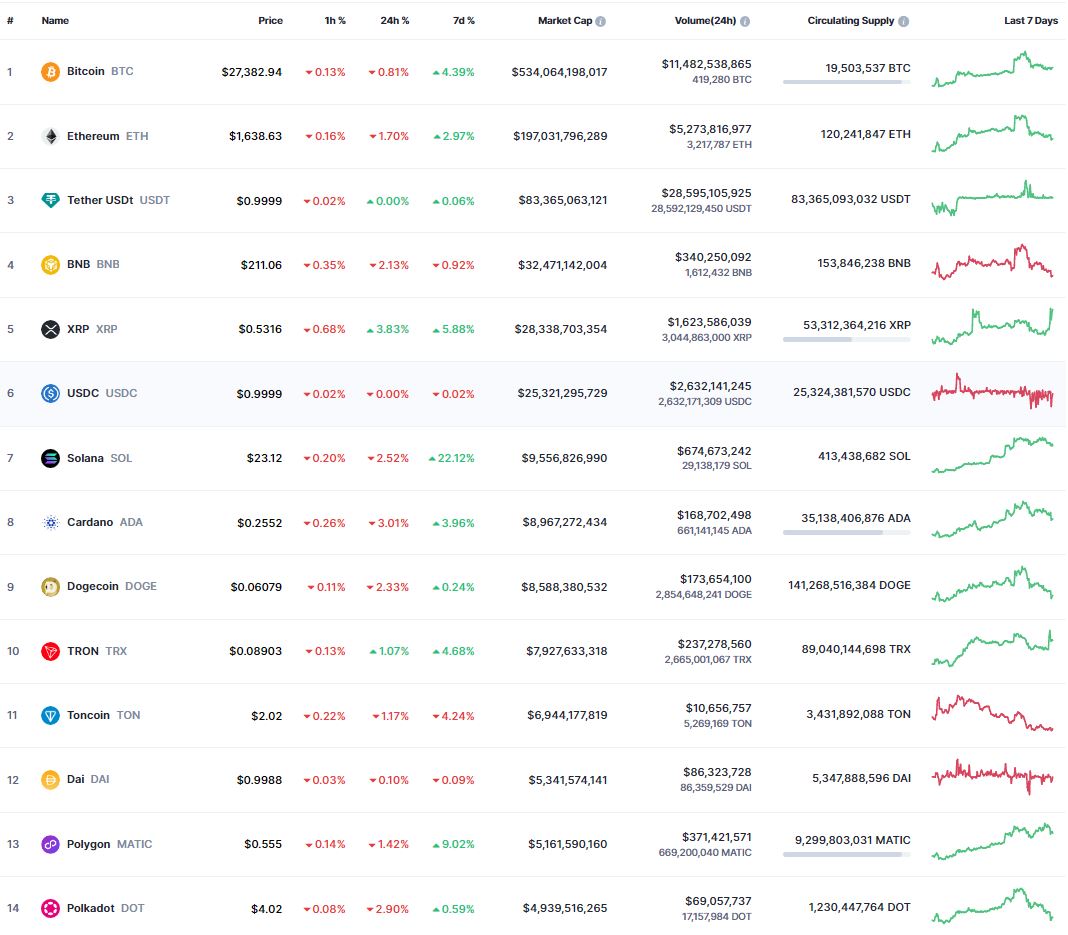
CRYPTO UPDATE AS OF OCTOBER 3, 2023:
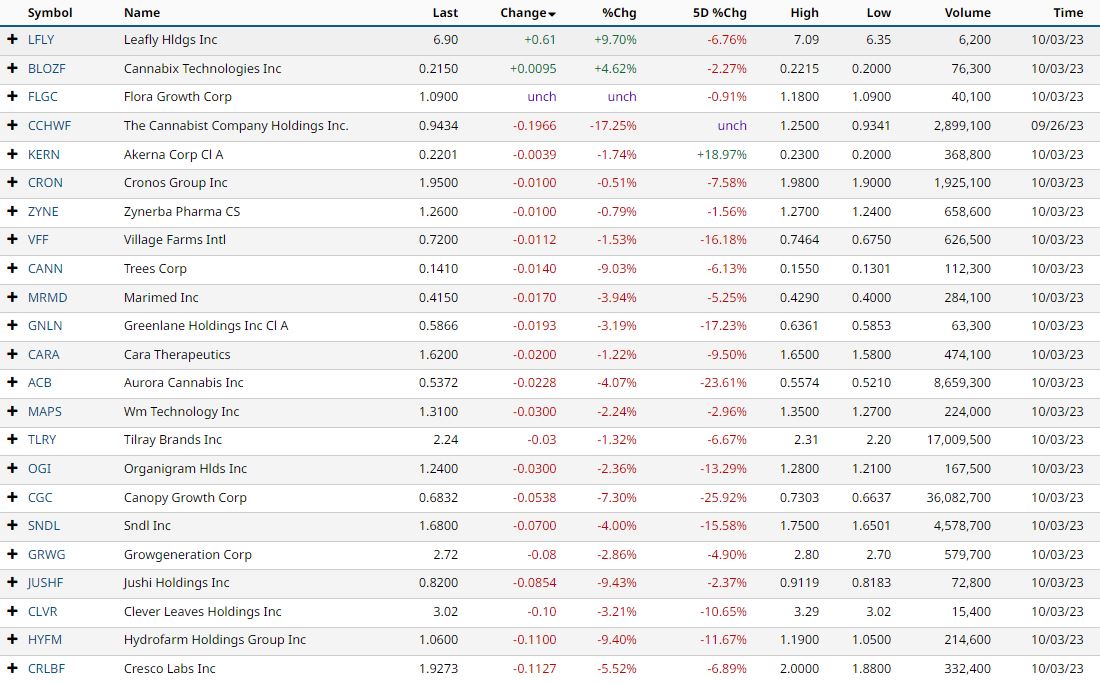
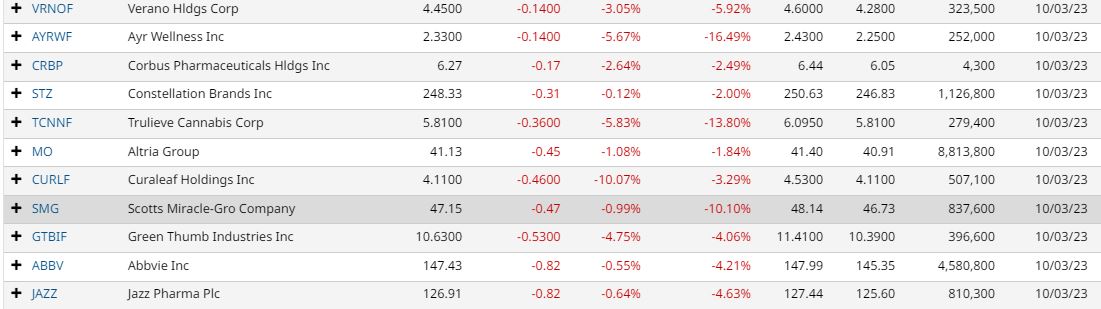
CANNABIS MOVERS AND SHAKERS OCTOBER 3, 2023:

WeWork On Brink Of Default As $95 Million In Interest Payments Skipped -ZeroHedge
WeWork Inc. skipped interest payments totaling $95 million due on Monday on five of its bonds, triggering a 30-day grace period. This comes two months after the struggling co-working start-up warned that “substantial doubt exists” about staying in business and one month after WeWork CEO David Tolley said the company “will seek to negotiate terms with our landlords” for underperforming locations.
“As such, today we entered into the 30-day grace period provided to us under our secured notes’ indentures and withheld the associated interest payments,” WeWork wrote in a press release on its website on Monday.
A regulatory filing shows the co-working firm withheld $37.3 million of cash and $57.9 million of interest payments on the following notes, all due in 2027:
15.000% First Lien Senior Secured PIK Notes due 2027;
11.000% Second Lien Senior Secured PIK Notes due 2027;
11.000% Second Lien Exchangeable Senior Secured PIK Notes due 2027;
12.000% Third Lien Senior Secured PIK Notes due 2027; and
12.000% Third Lien Exchangeable Senior Secured PIK Notes due 2027.
The filing continued, “The Company has a 30-day grace period to make the Interest Payments before such non-payment constitutes an ‘event of default’ with respect to the Notes.”
It added: “The Company has the liquidity to make the Interest Payments, and may in the future decide to do so.”
If WeWork has enough liquidity to service its debt, why would it miss payments?
Perhaps a conversation the WeWork CEO had with The New York Times can shed some light on this question:
“I believe they will absolutely understand our decision to enter into the grace period,” WeWork’s interim chief executive, David Tolley, said in an interview. He called the move “typical” as a “precursor to a conversation.”
“Skipping an interest payment is not necessary to negotiate with lenders. But it is a move sometimes used by indebted companies to put pressure on lenders to restrike deals under more favorable terms,” NYTimes noted.
What happens if the government shuts down: An illustrated guide-CNN
With Congress barreling toward a government shutdown, many Americans are wondering how it could affect them. Here’s a guide to what you can expect.
What is a government shutdown?
A government shutdown happens when Congress doesn’t approve funding for the federal government by the time the new fiscal year starts on October 1. Each year, Congress must pass the 12 appropriation bills that make up the discretionary spending budget and set funding levels for federal agencies.
What happens during a government shutdown?
If lawmakers fail to enact all or some of the appropriation bills, many government operations grind to a halt, resulting in a full or partial government shutdown until Congress acts. However, government functions that are deemed essential will continue.
Each federal agency comes up with a contingency plan that outlines which of its functions will continue during a shutdown and which will stop, as well as how many of its employees will continue working and how many will be furloughed until the shutdown ends.
What it means for you
Because many federal workers are off the job during a government shutdown, many services are stopped or slowed, disturbing the day-to-day life for many Americans.
Notably, Social Security payments to seniors, Americans with disabilities and others would continue to be distributed. The Postal Service will also continue regular service.
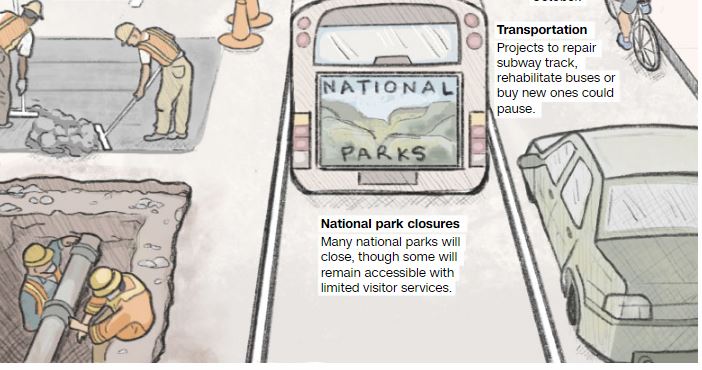
Here are some examples of how a shutdown could affect you.

JPMorgan CEO Jamie Dimon Says This Is the Number One Risk Threatening Global Economy – And It’s Not Inflation – The Daily Hodl

Jamie Dimon is comparing the current American market sentiment to a sugar high and is concerned many are unprepared for what is on the horizon. He advises investors to batten down the hatches and prepare for some hardship ahead.
by Henry Kanapi
JPMorgan chief executive Jamie Dimon says that the global economy is facing a far greater risk than persistent inflation or high interest rates.
In a new interview on CNBC India, Dimon says that people should prepare for higher oil and gas prices as well as higher interest rates.
While Dimon is urging people and businesses to be ready for higher energy costs along with tight monetary policies, he highlights that his number one concern is the current geopolitical situation.
According to Dimon, the war in Ukraine is negatively impacting oil, gas and food prices. He also notes that it is “affecting all global relationships.”
“I think the geopolitical situation is the thing that most concerns me, and we don’t know the effect of that on the economy. Again, I think the humanitarian part – that’s far more important.
I think it’s very important for the future of the free democratic world. We may be at an inflection point for the free democratic world. That’s how seriously I take it…
We have dealt with inflation before, we have dealt with deficits before [and] we have dealt with recessions before. We haven’t really seen something like this pretty much since World War II … There is no playbook.”
The SEC is Snooping on All Your Trades
EDITOR’S NOTE: The War on Cash is fought on a variety of fronts but the end result is always a loss of liberty and privacy for us all. The SEC’s sharing of the data on every market move we make is just the latest strategy. While the tracking should be alarming in and of itself, the threat of this information being open to hacking is of even greater concern. A centralized database to track every American investor is, without question, an unconstitutional data grab; but can it be stopped?
What’s in Your Portfolio? The SEC is Snooping on All Your Trades -MishTalk.com
portfolioThe SEC is now tracking your stock trades by your Social Security Number. It shares the data with 3,000 outside agencies.
In 2012 the SEC approved a new rule requiring a Consolidated Audit Trail to Monitor and Analyze Trading Activity.
“A consolidated audit trail that accurately tracks orders throughout their lifecycle and identifies the broker-dealers handling them will provide us with an unprecedented ability to effectively oversee the markets we regulate,” said SEC Chairman Mary Schapiro.
The new rule becomes effective 60 days after its publication in the Federal Register. SROs are required to submit the NMS plan to the Commission within 270 days of the rule’s publication in the Federal Register. Once the Commission approves the NMS plan, the SROs are required to report the required data to the central repository within one year, and members of the SROs are required to report within two years. Certain small broker-dealers will have up to three years to report the data.
This ruling was in response to a 2010 flash crash and quietly sat for years. The SEC is now following through.
The scope of the Consolidated Audit Trail, or CAT, a regulation the SEC issued in 2016 but implemented only recently, is breathtaking and unprecedented. In the words of the SEC press release, the regulation instructs regulated financial institutions to identify “every order, cancellation, modification and trade execution for all exchange-listed equities and options across all U.S. markets.”
‘Bond King’ Jeffrey Gundlach warns of ‘demons on the horizon’ for stocks – and predicts a dollar disaster and recession next year -Yahoo! Finance

by Theron Mohamed
Jeffrey Gundlach issued a slew of warnings about the stock market, the US dollar, and an upcoming recession during the Future Proof conference last week.
The S&P 500 and Nasdaq Composite have surged 16% and 31% respectively this year, as investors price in the potential boost to companies from artificial intelligence and future cuts to interest rates. However, they’re overlooking “demons on the horizon,” Gundlach cautioned.
The billionaire CEO of DoubleLine Capital highlighted signs of a faltering US economy as a key concern. He pointed to a recent wave of corporate layoffs, and consumers feeling the squeeze from record amounts of credit-card debt as red flags. He also noted the chilling effect of higher mortgage rates on the housing market, and the challenge for small businesses of having to refinance their debts at much higher interest rates.
“The economy is definitely weakening,” Gundlach said. “I look for one next year, and I think the indicators are getting really convincing in that regard,” he said about the prospect of a recession.
The fund manager — whose nickname is the “Bond King” — also argued that economic growth has been shored up this year by a dangerous and unsustainable amount of government spending.
“The economy is only growing because we have a budget deficit that is 8% of GDP,” he said. “It’s about the same today as the depths of the global financial crisis.”
Gundlach underscored that the federal government financed most of its spending at rock-bottom rates. However, the Federal Reserve’s war on inflation has seen it hike rates from nearly zero to over 5% since last spring, meaning the government’s interest charges on trillions of dollars of debt are poised to balloon.
What about the January Barometer?

The January Barometer calls for a positive year-end outcome, but a lot can happen between now and then. Please check with previous editions discussing the calculation of the Barometer.


https://tinyurl.com/2rd9wv52
OPPORTUNITY TO ACCESS MARK LEIBOVIT’S PROPRIETARY VOLUME REVERSAL INDICATOR – THIS IS THE ONLY PLACE TO DO IT!
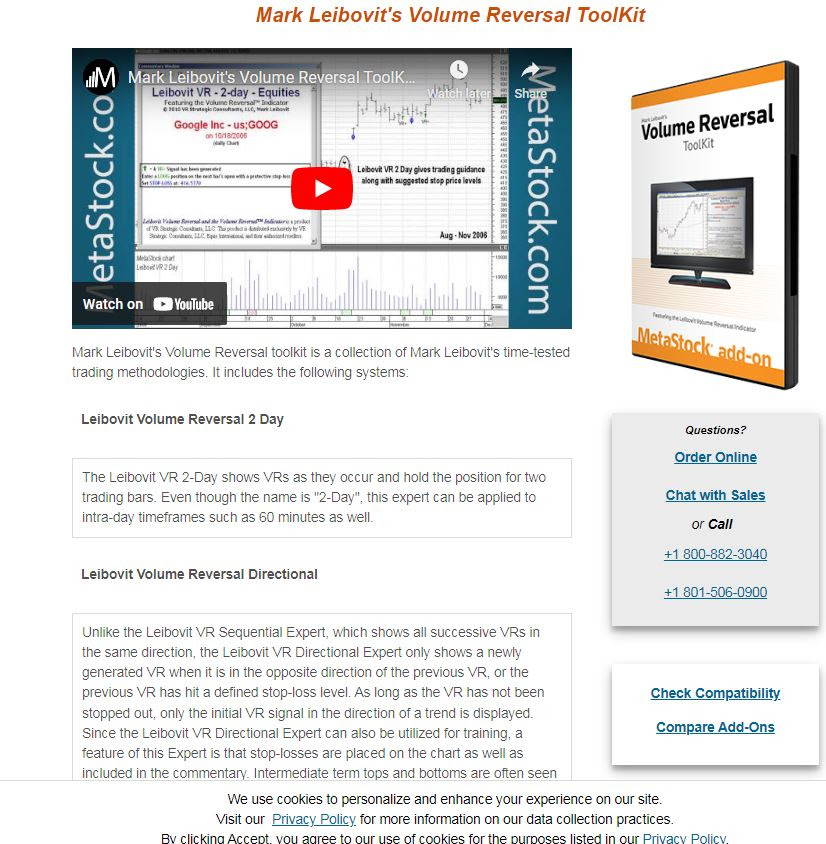
https://www.metastock.com/
COME ON, DAD. IT’S TIME TO EAT

DISCLAIMER:
WE ARE NOT FINANCIAL ADVISORS AND DO NOT PROVIDE FINANCIAL ADVICE
The website, LeibovitVRNewsletters.com, is published by LeibovitVRNewsletters LLC.
In using LeibovitVRnewsletters.com (a/k/a LeibovitVRNewsletters LLC) you agree to these Terms & Conditions governing the use of the service. These Terms & Conditions are subject to change without notice. We are publishers and are not registered as a broker-dealer or investment adviser either with the U.S. Securities and Exchange Commission or with any state securities authority.
All stocks and ETFs discussed are HYPOTHETICAL and not actual trades whose actual execution may differ markedly from prices posted on the website and in emails. This may be due internet connectivity, quote delays, data entry errors and other market conditions. Hypothetical or simulated performance results have certain inherent limitations as to liquidity and execution among other variables. PAST RESULTS ARE NOT NECESSARILY INDICATIVE OF FUTURE FORECASTING ACCURACY OR PROFITABLE TRADING RESULTS.
All investments are subject to risk, which should be considered on an individual basis before making any investment decision. We are not responsible for errors and omissions. These publications are intended solely for information and educational purposes only and the content within is not to be construed, under any circumstances, as an offer to buy or to sell or a solicitation to buy or sell or trade in any commodities or securities named within.
All commentary is provided for educational purposes only. This material is based upon information we consider reliable. However, accuracy is not guaranteed. Subscribers should always do their own investigation before investing in any security. Furthermore, you cannot be assured that your will profit or that any losses can or will be limited. It is important to know that no guarantee of any kind is implied nor possible where projections of future conditions in the markets are attempted.
Stocks and ETFs may be held by principals of LeibovitVRNewsletters LLC whose personal investment decisions including entry and exit points may differ from guidelines posted.
LeibovitVRNewsletters.com cannot and do not assess, verify or guarantee the suitability or profitability of any particular investment. You bear responsibility for your own investment research and decisions and should seek the advice of a qualified securities professional before making any investment. As an express condition of using this service and anytime after ending the service, you agree not to hold LeibovitVRNewsletters.com or any employees liable for trading losses, lost profits or other damages resulting from your use of information on the Site in any form (Web-based, email-based, or downloadable software), and you agree to indemnify and hold LeibovitVRNewsletters.com and its employees harmless from and against any and all claims, losses, liabilities, costs, and expenses (including but not limited to attorneys’ fees) arising from your violation of this agreement. This paragraph is not intended to limit rights available to you or to us that may be available under the federal securities laws.
For rights, permissions, subscription and customer service, contact the publisher at mark.vrtrader@gmail.com or call at 928-282-1275 or mail to 10632 N. Scottsdale Road B-426, Scottsdale, AZ 85254.
The Leibovit Volume Reversal, Volume Reversal and Leibovit VR are registered trademarks.
© Copyright 2023. All rights reserved.
[/fusion_text][/fusion_builder_column][/fusion_builder_row][/fusion_builder_container]