

THE VR FORECASTER 2022 AFM BELOW
https://tinyurl.com/edav6erv

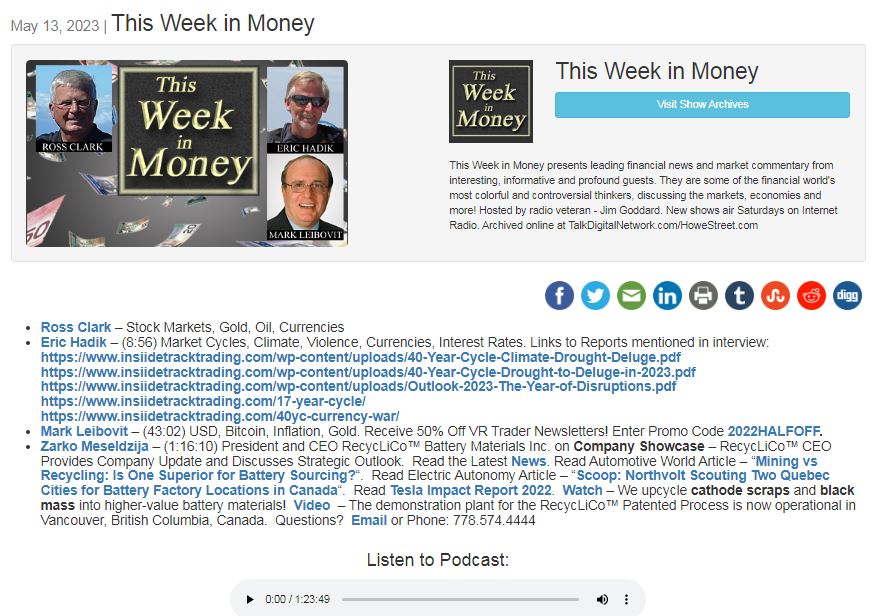
https://www.howestreet.com/2023/05/gold-oil-market-cycles-inflation-currencies-eric-hadik-mark-leibovit-ross-clark-this-week-in-money/



FROM 2007 – REP RON PAUL:

IT IS TIME TO REPEAL THE 16TH AMENDMENT – THE ONE THAT CREATES INCOME TAX

THE CASE FOR ABOLISHING THE FEDERAL RESERVE


——————————
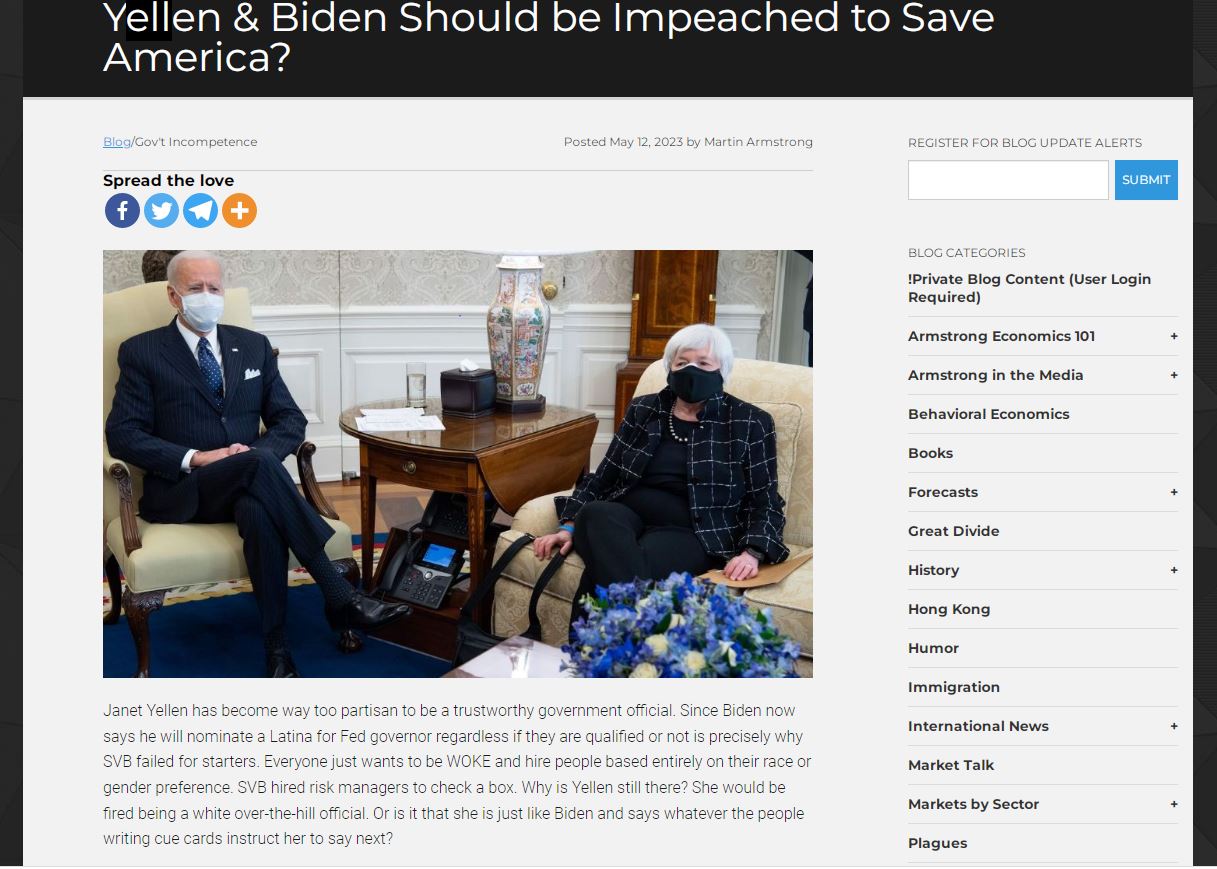
https://tinyurl.com/3ycunb73
Move over, U.S. dollar. China wants to make the yuan the global currency. – The Washington Post
by Meaghan Tobin, Lyric Li, David Feliba
 Newsan, one of Argentina’s biggest home appliance retailers, imports most of its products from China. Until now, it was paying for fridges, TVs and parts in U.S. dollars, the currency of international trade.
But last month, as part of a bid to relieve pressure on Argentina’s dollar-strapped economy, Newsan started doing something new: settling deals in Chinese yuan.
“The yuan is becoming increasingly relevant as currency for international trade,” said Luis Galli, chief executive of Newsan. “But beggars don’t get to choose. This deal was born out of necessity.”
Argentina’s economy is — again — in crisis. A drought has wiped out key agricultural exports, pushing the economy, already grappling with skyrocketing inflation, to the brink of recession.
With Argentina’s supply of U.S. dollars dwindling as a result, the government in April announced it would pay for $1 billion worth of imports from China in yuan — and for $790 million worth of monthly imports thereafter.
It also activated a currency swap agreement, making it possible for companies to borrow yuan from China, Argentina’s second-largest trading partner.
The deal was welcome news for Beijing, which has long wanted its currency in wider use and to enjoy some of the power and prestige that the United States enjoys thanks to the dollar’s global domination.
It wasn’t having much luck — until recently. Suddenly more customers are willing to settle their bills in Chinese yuan, thanks variously to domestic economic crises, Western sanctions against Russia, China’s position as a major lender and growing concerns about being beholden to Washington’s policies.

“A Lot More Bodies Coming” – Druckenmiller Warns Of “Hard Landing”, Blasts Fed “Free Money” Making People Do “Really Stupid Things” – Zero Hedge
by Tyler Durden
 Stan Druckenmiller thinks the US economy is teetering on the edge of a recession, predicting a “hard landing”, and warning that “there’s a lot more bodies coming” with regarding regional banks and corporate bankruptcies.
The billionaire founder of Duquesne Family Office said Tuesday during the 2023 Sohn Investment Conference that it’s a really hard time to come up with an accurate economic forecast, slamming “Jerome Powell’s Fed” for having its “foot on the gas” even though the risk of inflation was apparent amid the recovery from COVID.
Druckenmiller has been a big critic of what he calls the Fed’s too-easy monetary policy and continued that today. He noted that there have only been a few soft landings since 1950, and the odds of that happening are tough, highlighting Bed Bath & Beyond’s bankruptcy and warning that there could be more to come (specifically mentioning the struggles in the CRE space and that regional banks are a big lender to the space.
“…when you have free money, people do stupid things. When you have free money for 11 years, people do really stupid things. So there’s stuff under the hood, it’s starting to emerge. Obviously the regional banks recently, we had Bed Bath and Beyond. But I would assume there’s a lot more bodies coming.” READ MORE
Fewer Than 60% Of Baby Boomers Have Retirement Accounts – Zero Hedge
Authored by Katabella Roberts via The Epoch Times
 Millions of working-age Americans aged between 56 and 64 are edging closer to retirement without having savings stashed away.
Census data for 2020 shows that less than 60 percent (approximately 58.1 percent) of American “baby boomers”—generally defined as those born between 1946 to 1964—owned a retirement account three years ago, at a time when the COVID-19 pandemic upended jobs and the global economy.
That means over two-fifths of baby boomers nearing retirement had no retirement savings stored in financial institutions.
The U.S. Census Bureau defined retirement accounts as 401(k), 403(b), 503(b), Thrift Savings Plans, Individual Retirement Accounts (IRA), Keogh accounts, and defined-benefit and cash balance plans.
The Census data also revealed that just 56.1 percent of “Generation X” members, or those aged between 40 and 55 had a retirement account in 2020, while roughly half of “millennials” ages 24 to 39 had one.
Meanwhile, just 7.7 percent of Americans who fall under the “Generation Z” category, meaning those aged 15 to 23, owned retirement accounts in 2020. However, given their ages, they also have more time to accumulate additional retirement savings.
The coming threat to commercial real estate, construction and jobs
Opinion: A ‘perfect storm’ from higher interest rates and a credit crunch threatens commercial real estate, construction and jobs
By John F. Fish
 With $1.5 trillion in loans maturing in the next two years, developers and landlords need more time to restructure and repay debt
As the U.S. emerges from the COVID-19 pandemic, much attention has been given to rising inflation and the interest-rate hikes to combat it. But there is another looming threat with equally impactful and widespread implications for consumers and the economy: commercial real estate. About $1.5 trillion worth of commercial real estate loans are due to mature over the next two years, at a steep increase.
The combination of the tightening of lending conditions and loans refinanced at higher, unsustainable rates could potentially stifle construction and development in major cities struggling to bounce back from the pandemic.
To avoid inflicting more far-reaching economic uncertainty, the Federal Reserve and the financial services regulatory agencies should grant more time for borrowers — including corporate real estate developers — to restructure commercial real estate loans.
This strategy has a proven track record of success. During the 2008-09 financial crisis and again in the COVID-19 pandemic, similar programs provided financial institutions flexibility to work constructively with borrowers. In the summer of 2022, the Board of Governors at the Fed proposed a comparable policy. Granting borrowers more time to adjust the economic climate makes more sense than pushing loans that could result in more foreclosures and bankruptcies.
Failure to act will hurt more than just those holding these loans. The perfect storm brewing from higher interest rates, lower real estate values and an illiquid market will burden consumers, businesses, stall affordable housing expansion and further imperil the health of our major metropolitan areas.
Consider that the bulk of commercial real estate loans were financed when base rates were near zero — far below today’s rates closer to 5%. Not only are the rates higher, but the real estate values are much lower, especially in cities afflicted with high vacancy rates from ongoing work-from-home policies. Prior to the pandemic, 95% of U.S. offices were occupied. Today, that number is closer to 47%. The drop wiped out $453 billion of commercial real-estate value, according to the U.S. National Bureau of Economic Research (NBER).
Brace yourselves, the banking crisis is just getting started – Yahoo! Finance
By Ben Marlow
|
|
Photo by Remy Steinegger |

If Jamie Dimon was pondering a career change as a fortune-teller, he’d be wise to stick to the day job. On the other hand, if someone of Dimon’s stature could be so wrong about the banking turmoil that continues to sweep across the US, a cynic might ask whether he was still the right person to be running one of the world’s largest financial institutions, particularly when that organisation is right at the centre of Government-led efforts to prop up the whole system.
Having ridden to the rescue of California lender First Republic over the weekend, JP Morgan’s superstar boss had a message for financial markets: its shotgun takeover of First Republic heralded the end of the crisis. He should know better than to be drawn into the realms of speculation about things he has no control of but then Wall Street is so deferential to figures like Dimon that they start to believe they can walk on water.
Still, the speed with which Dimon’s words have come back to haunt him comes as a shock. A mere 48 hours later, and it looked as though the game was up for yet another regional American bank – the fourth since the end of March.
“It’s Spooky”: Stanford Professor Warns Thousands Of US Banks Are “Potentially Insolvent”
Following the collapse of First Republic last week, the meltdown of three other banks, and the Federal Reserve’s quarter-point increase,
making the tenth straight hike in an aggressive campaign to tame elevated inflation, a professor of finance at the Stanford Graduate
School of Business presented a grim warning that the regional banking dominos are falling.
In a New York Times opinion piece titled “Yes, You Should Be Worried About a Potential Bank Crisis. Here’s Why,” Professor Amit Seru
wrote, “the fragility and collapse of several high-profile banks are most likely not an isolated phenomenon.” He said, “A damaging
combination of fast-rising interest rates, major changes in work patterns, and the potential of a recession could prompt a credit crunch
not seen since the 2008 financial crisis.”
Just in the past few months, Silicon Valley Bank, Signature Bank and First Republic Bank have failed. Their combined assets surpassed
those held by the 25 banks (when adjusted for inflation) that collapsed at the height of the financial crisis. While some experts and
policymakers believe that the resolution of First Republic Bank on Monday indicates the turbulence in the industry is coming to an end, I
believe this may be premature. On Thursday, shares of PacWest and Western Alliance are falling as investors’ fears spread. Adverse
conditions have significantly weakened the ability of many banks to withstand another credit shock — and it’s clear that a big one may
already be on its way.
Rapidly rising interest rates create perilous conditions for banks because of a basic principle: The longer the duration of an
investment, the more sensitive it is to changes in interest rates. When interest rates rise, the assets that banks hold to generate a
return on their investment fall in value. And because the banks’ liabilities — like its deposits, which customers can withdraw at any
time — usually are shorter in duration, they fall by less. Thus, increases in interest rates can deplete a bank’s equity and risk leaving
it with more liabilities than assets. So it’s no surprise that the US banking system’s market value of assets is around $2 trillion lower
than suggested by their book value. When the entire set of approximately 4,800 banks in the United States is examined, the decline in the
value of equity is most prominent for midsize and smaller banks, reflecting their heavier bets on long-term assets.
Since monetary tightening works in long lags (9-12 months), many of the rate hikes over the last year have yet to filter through the real
economy. In the coming quarters, the US banking system will face its toughest challenge yet, as tightening lending standards might spark
more breaking.
In Seru’s NYTimes op-ed piece, he noted, “There’s another looming area of concern that could spark such panic: The commercial real estate
sector.”
Commercial real estate loans, worth $2.7 trillion in the United States, make up around a quarter of an average bank’s assets. Many of
these loans are coming due in the next few years, and refinancing them at higher rates naturally increases the risk of default. Rising
interest rates also depress the value of commercial properties, especially those with long-term leases and limited rent escalation
clauses, which also increases the likelihood of owner default. In the Great Recession, for example, default rates rose to about 9
percent, up from around 1 percent, as interest rates rose.
For Zerohedge readers, the dual crises affecting regional banks and the commercial real estate sector (offices) isn’t a new thesis. We
first proposed the coming turmoil on Mar. 21 in a note titled “”Nowhere To Hide In CMBS”: CRE Nuke Goes Off With Small Banks Accounting
For 70% Of Commercial Real Estate Loans”. We’ve documented the unfolding crisis spreading from regional banks to the CRE space in
numerous pieces (many of which can be found in our premium section).
Our latest note, featuring BofA strategist Michael Hartnett highlights that “every Fed tightening cycle ends in crisis”, in this case US
regional banks.
Finally, the apocalyptic warning about the US banking system comes as JPMorgan CEO Jamie Dimon claims that “the system is very, very
sound.”
https://www.zerohedge.com/markets/its-spooky-stanford-professor-warns-thousands-us-banks-are-insolvent?
utm_source=&utm_medium=email&utm_campaign=1469
BIDEN HAS TO GO BUT WILL VOTER FRAUD PREVENT IT?
It’s official. President Joe Biden is running for re-election and taking Vice President Kamala Harris along with him.
In only two years at the White House, Biden has caused enormous damage to the country, threatened U.S. national security and weakened
America throughout the world with his disastrous foreign policy.
In his re-election video, Biden claims he’s standing up for the freedoms of Americans. Reality and Biden’s actions tell a different
story.
Biden has repeatedly targeted political opponents with the full force of the federal government and violated the fundamental rights of
Americans. He’s destroyed the economy with sky-high inflation, implemented Marxist policies in the mortgage system (which will lead to
another housing crisis) and forced hardworking Americans to pay off the student debt of wealthy degree holders. He’s made it a habit of
tearing down fundamental American values about hard work and personal responsibility. All of this while partnering with his son Hunter to
sell out the country to foreign adversaries.
Biden talks about freedom, yet he’s targeting your Second Amendment rights with calls for gun bans and by signing executive orders.
Government bureaucrats, with his endorsement, have violated the First Amendment through Big Tech censorship. Not to mention his efforts
to fire thousands of Americans after they said no thank you to an ineffective vaccine.

DISCLAIMER:
WE ARE NOT FINANCIAL ADVISORS AND DO NOT PROVIDE FINANCIAL ADVICE
The website, LeibovitVRNewsletters.com, is published by LeibovitVRNewsletters LLC.
In using LeibovitVRnewsletters.com (a/k/a LeibovitVRNewsletters LLC) you agree to these Terms & Conditions governing the use of the service. These Terms & Conditions are subject to change without notice. We are publishers and are not registered as a broker-dealer or investment adviser either with the U.S. Securities and Exchange Commission or with any state securities authority.
All stocks and ETFs discussed are HYPOTHETICAL and not actual trades whose actual execution may differ markedly from prices posted on the website and in emails. This may be due internet connectivity, quote delays, data entry errors and other market conditions. Hypothetical or simulated performance results have certain inherent limitations as to liquidity and execution among other variables. PAST RESULTS ARE NOT NECESSARILY INDICATIVE OF FUTURE FORECASTING ACCURACY OR PROFITABLE TRADING RESULTS.
All investments are subject to risk, which should be considered on an individual basis before making any investment decision. We are not responsible for errors and omissions. These publications are intended solely for information and educational purposes only and the content within is not to be construed, under any circumstances, as an offer to buy or to sell or a solicitation to buy or sell or trade in any commodities or securities named within.
All commentary is provided for educational purposes only. This material is based upon information we consider reliable. However, accuracy is not guaranteed. Subscribers should always do their own investigation before investing in any security. Furthermore, you cannot be assured that your will profit or that any losses can or will be limited. It is important to know that no guarantee of any kind is implied nor possible where projections of future conditions in the markets are attempted.
Stocks and ETFs may be held by principals of LeibovitVRNewsletters LLC whose personal investment decisions including entry and exit points may differ from guidelines posted.
LeibovitVRNewsletters.com cannot and do not assess, verify or guarantee the suitability or profitability of any particular investment. You bear responsibility for your own investment research and decisions and should seek the advice of a qualified securities professional before making any investment. As an express condition of using this service and anytime after ending the service, you agree not to hold LeibovitVRNewsletters.com or any employees liable for trading losses, lost profits or other damages resulting from your use of information on the Site in any form (Web-based, email-based, or downloadable software), and you agree to indemnify and hold LeibovitVRNewsletters.com and its employees harmless from and against any and all claims, losses, liabilities, costs, and expenses (including but not limited to attorneys’ fees) arising from your violation of this agreement. This paragraph is not intended to limit rights available to you or to us that may be available under the federal securities laws.
For rights, permissions, subscription and customer service, contact the publisher at mark.vrtrader@gmail.com or call at 928-282-1275 or mail to 10632 N. Scottsdale Road B-426, Scottsdale, AZ 85254.
The Leibovit Volume Reversal, Volume Reversal and Leibovit VR are registered trademarks.
© Copyright 2023. All rights reserved.