

U.S. MARKETS:
Capping off a strong week for the markets, stocks moved considerably higher during the trading session on Friday. The Dow and the S&P 500 closed higher for the fifth straight
day, while the tech-heavy Nasdaq extended its winning streak to six sessions.
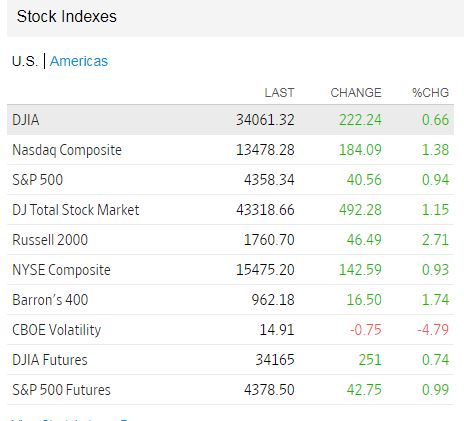
The major averages pulled back off their best levels going into the close but remained firmly positive. The Nasdaq surged 184.09 points or 1.4 percent to 13,478.28, the S&P 500
jumped 40.56 points or 0.9 percent to 4,358.34 and the Dow advanced 222.24 points or 0.7 percent to 34,061.32.
For the week, the Nasdaq skyrocketed by 6.6 percent, the S&P 500 soared by 5.9 percent and the Dow spiked by 5.1 percent.
The continued strength on Wall Street reflects a positive reaction to a Labor Department report showing U.S. employment rose by less than expected in the month of October.
The closely watched report said employment climbed by 150,000 jobs in October after jumping by a downwardly revised 297,000 jobs in September.
Economists had expected employment to increase by 180,000 jobs compared to the surge of 336,000 jobs originally reported for the previous month.
The Labor Department also said the unemployment rate crept up to 3.9 percent in October from 3.8 percent in September. The unemployment rate was expected to remain unchanged.
The data has added to optimism the Federal Reserve is done raising interest rates after the central bank left rates unchanged for the third time in four meetings earlier this
week.
Treasury yields are extending a recent slump following the release of the report, adding to the buying interest on Wall Street.
“Given that jobs growth is slowing and the unemployment rate is ticking up slightly, that is the kind of data that will keep the Fed on hold and both stock and bond prices
should move higher (bond yields lower) in the absence of a more aggressive Fed,” said Chris Zaccarelli, Chief Investment Officer for Independent Advisor Alliance.
A separate report released by the Institute for Supply Management showed a bigger than expected slowdown in the pace of growth in U.S. service sector activity in the month of
October.
The ISM said its services PMI fell to 51.8 in October from 53.6 in September, although a reading above 50 still indicates growth. Economists had expected the index to edge down
to 53.0.
Sector News
Airline stocks saw substantial strength on the day, driving the NYSE Arca Airline Index up by 4.9 percent. The index continued to recover after ending Wednesday’s trading at
its lowest closing level in over three years.
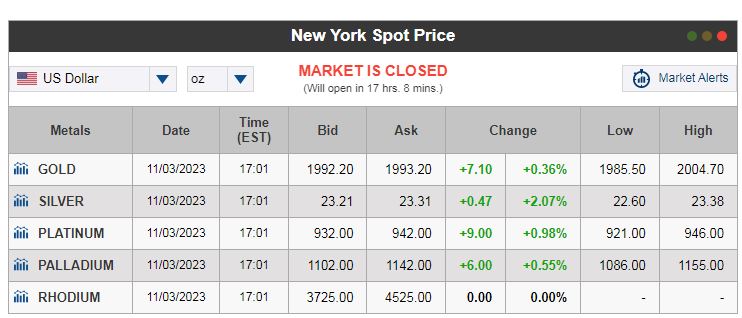
Considerable strength was also visible among gold stocks, as reflected by the 4.4 percent spike by the NYSE Arca Gold Bugs Index.
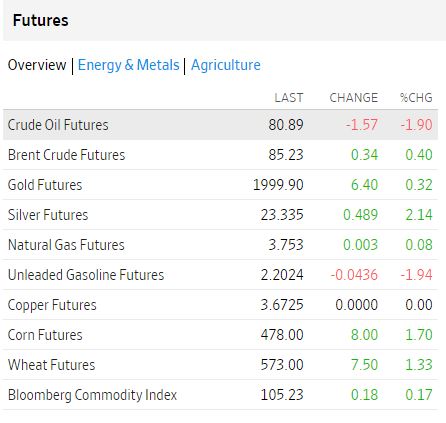
The rally by gold stocks came amid a modest increase by the price of the precious metal, with gold for December delivery inching up $5.70 to $1,999.20 an ounce.
Interest-sensitive housing stocks also turned in a particularly strong performance, resulting in a 3.2percent surge by the Philadelphia Housing Sector Index.
Banking, biotechnology and telecom stocks also saw notable strength, while oil stocks were among the few groups to buck the uptrend amid a steep drop by the price of crude oil.
Other Markets
In overseas trading, stock markets across the Asia-Pacific region moved notably higher on Friday, with the Japanese markets closed for a holiday. Hong Kong’s Hang Seng Index
soared by 2.5 percent, while South Korea’s Kospi jumped by 1.1 percent.
Meanwhile, the major European markets turned in a mixed performance on the day. While the German DAX Index rose by 0.3 percent, the French CAC 40 Index dipped by 0.2 percent
and the U.K.’s FTSE 100 Index fell by 0.4 percent.
In the bond market, treasuries moved sharply higher, extending the strong upward move seen over the two previous sessions. As a result, the yield on the benchmark ten-year
note, which moves opposite of its price, tumbled by 11.1 basis points to 4.558 percent.
Looking Ahead
The economic calendar is relatively quiet next week, although traders are likely to keep an eye on reports on initial jobless claims, the U.S. trade deficit and consumer
sentiment along with remarks by Fed Chair Jerome Powell.
U.S. DOLLAR

CANADIAN DOLLAR
URANIUM
COMMODITIES

Could We See Traditional Fall Market Rally?
https://www.howestreet.com/2023/11/could-we-see-traditional-fall-market-rally-mark-leibovit/

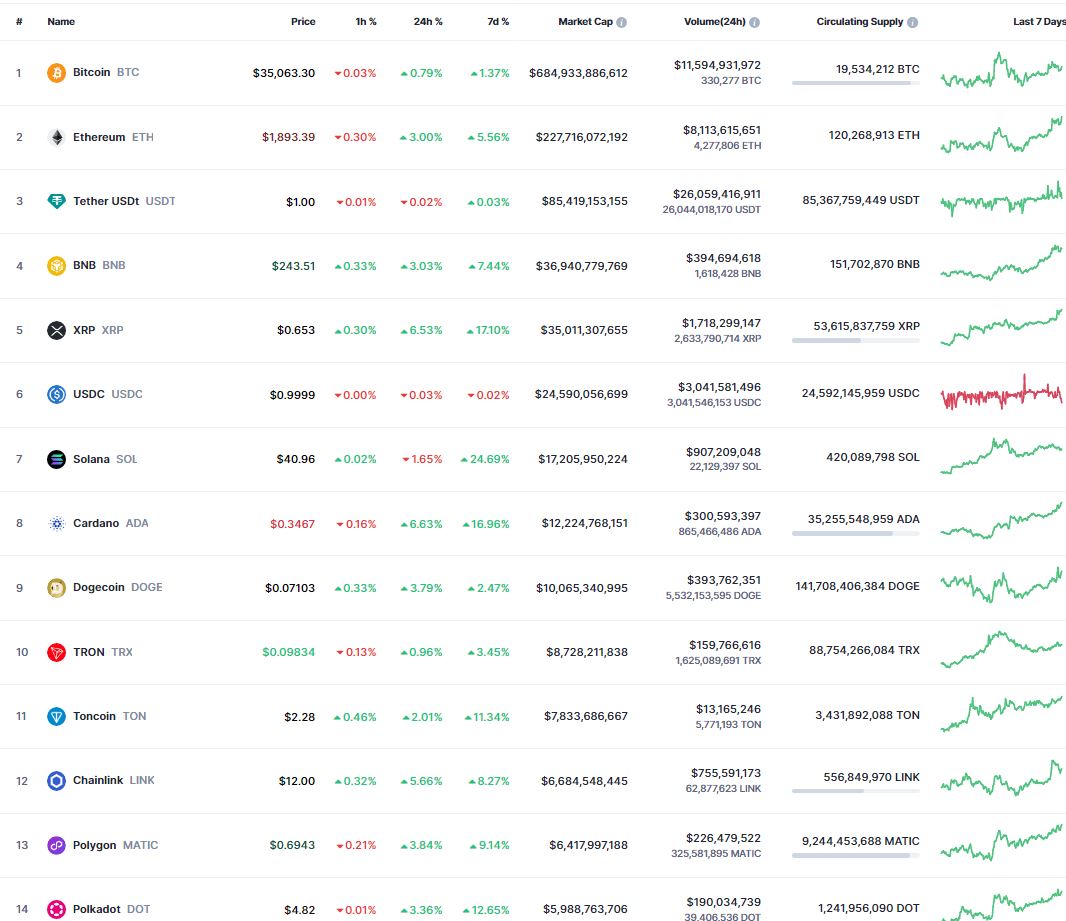
CRYPTO UPDATE AS OF NOVEMBER 5, 2023:




https://tinyurl.com/2rd9wv52
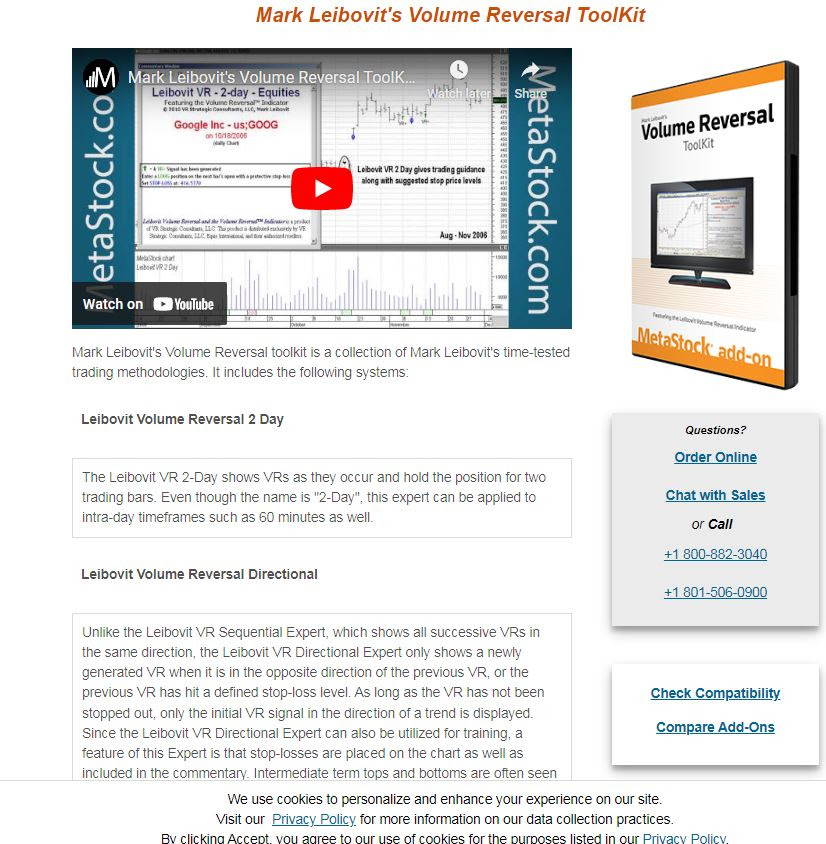
OPPORTUNITY TO ACCESS MARK LEIBOVIT’S PROPRIETARY VOLUME REVERSAL INDICATOR – THIS IS THE ONLY PLACE TO DO IT!
https://www.metastock.com/




FROM 2007 – REP RON PAUL:

THE CASE FOR ABOLISHING THE FEDERAL RESERVE
G EDWARD GRIFFIN

https://www.youtube.com/watch?

The President’s Working Group on Financial Markets
known colloquially as the Plunge Protection Team, or “(PPT)” was created by Executive Order 12631,[1] signed on March 18, 1988, by United States President Ronald Reagan.
As established by the executive order, the Working Group has three purposes and functions:
“(a) Recognizing the goals of enhancing the integrity, efficiency, orderliness, and competitiveness of our Nation’s financial markets and maintaining investor confidence, the Working Group shall identify and consider:
(1) the major issues raised by the numerous studies on the events in the financial markets surrounding October 19, 1987, and any of those recommendations that have the potential to achieve the goals noted above; and
(2) the actions, including governmental actions under existing laws and regulations (such as policy coordination and contingency planning), that are appropriate to carry out these recommendations.
(b) The Working Group shall consult, as appropriate, with representatives of the various exchanges, clearinghouses, self-regulatory bodies, and with major market participants to determine private sector solutions wherever possible.
(c) The Working Group shall report to the President initially within 60 days (and periodically thereafter) on its progress and, if appropriate, its views on any recommended legislative changes.”
Plunge Protection Team
“Plunge Protection Team” was originally the headline for an article in The Washington Post on February 23, 1997, and has since been used by some as an informal term to refer to the Working Group. Initially, the term was used to express the opinion that the Working Group was being used to prop up the stock markets during downturns.[5 Financial writers for British newspapers The Observer and The Daily Telegraph, along with U.S. Congressman Ron Paul, writers Kevin Phillips (who claims “no personal firsthand knowledge” and John Crudele,[8] have charged the Working Group with going beyond their legal mandate.[failed verification] Charles Biderman, head of TrimTabs Investment Research, which tracks money flow in the equities market, suspected that following the 2008 financial crisis the Federal Reserve or U.S. government was supporting the stock market. He stated that “If the money to boost stock prices did not come from the traditional players, it had to have come from somewhere else” and “Why not support the stock market as well? Moreover, several officials have suggested the government should support stock prices.”
In August 2005, Sprott Asset Management released a report that argued that there is little doubt that the PPT intervened to protect the stock market.[10] However, these articles usually refer to the Working Group using moral suasion to attempt to convince banks to buy stock index futures.
Former Federal Reserve Board member Robert Heller, in the Wall Street Journal, opined that “Instead of flooding the entire economy with liquidity, and thereby increasing the danger of inflation, the Fed could support the stock market directly by buying market averages in the futures market, thereby stabilizing the market as a whole.” Author Kevin Phillips wrote in his 2008 book Bad Money that while he had no interest “in becoming a conspiracy investigator”, he nevertheless drew the conclusion that “some kind of high-level decision seems to have been reached in Washington to loosely institutionalize a rescue mechanism for the stock market akin to that pursued…to safeguard major U.S. banks from exposure to domestic and foreign loan and currency crises.” Phillips infers that the simplest way for the Working Group to intervene in market plunges would be through buying stock market index futures contracts, either in cooperation with major banks or through trading desks at the U.S. Treasury or Federal Reserve.
The Exchange Stabilization Fund protects the FED.
We already know the FED is lying that raising interest rates will reduce price inflation. The Exchange Stabilization Fund (ESF) is an emergency reserve account that can be used by the U.S. Department of Treasury to mitigate instability in various financial sectors, including credit, securities, and foreign exchange markets. The U.S. Exchange Stabilization Fund was established at the Treasury Department by a provision in the Gold Reserve Act of 1934.
https://en.wikipedia.org/wiki/

Gold market manipulation: Why, how, and how long? (2021 edition)
https://gata.org/node/20925
COME ON, DAD. IT’S TIME TO EAT

DISCLAIMER:
WE ARE NOT FINANCIAL ADVISORS AND DO NOT PROVIDE FINANCIAL ADVICE
The website, LeibovitVRNewsletters.com, is published by LeibovitVRNewsletters LLC.
In using LeibovitVRnewsletters.com (a/k/a LeibovitVRNewsletters LLC) you agree to these Terms & Conditions governing the use of the service. These Terms & Conditions are subject to change without notice. We are publishers and are not registered as a broker-dealer or investment adviser either with the U.S. Securities and Exchange Commission or with any state securities authority.
All stocks and ETFs discussed are HYPOTHETICAL and not actual trades whose actual execution may differ markedly from prices posted on the website and in emails. This may be due internet connectivity, quote delays, data entry errors and other market conditions. Hypothetical or simulated performance results have certain inherent limitations as to liquidity and execution among other variables. PAST RESULTS ARE NOT NECESSARILY INDICATIVE OF FUTURE FORECASTING ACCURACY OR PROFITABLE TRADING RESULTS.
All investments are subject to risk, which should be considered on an individual basis before making any investment decision. We are not responsible for errors and omissions. These publications are intended solely for information and educational purposes only and the content within is not to be construed, under any circumstances, as an offer to buy or to sell or a solicitation to buy or sell or trade in any commodities or securities named within.
All commentary is provided for educational purposes only. This material is based upon information we consider reliable. However, accuracy is not guaranteed. Subscribers should always do their own investigation before investing in any security. Furthermore, you cannot be assured that your will profit or that any losses can or will be limited. It is important to know that no guarantee of any kind is implied nor possible where projections of future conditions in the markets are attempted.
Stocks and ETFs may be held by principals of LeibovitVRNewsletters LLC whose personal investment decisions including entry and exit points may differ from guidelines posted.
LeibovitVRNewsletters.com cannot and do not assess, verify or guarantee the suitability or profitability of any particular investment. You bear responsibility for your own investment research and decisions and should seek the advice of a qualified securities professional before making any investment. As an express condition of using this service and anytime after ending the service, you agree not to hold LeibovitVRNewsletters.com or any employees liable for trading losses, lost profits or other damages resulting from your use of information on the Site in any form (Web-based, email-based, or downloadable software), and you agree to indemnify and hold LeibovitVRNewsletters.com and its employees harmless from and against any and all claims, losses, liabilities, costs, and expenses (including but not limited to attorneys’ fees) arising from your violation of this agreement. This paragraph is not intended to limit rights available to you or to us that may be available under the federal securities laws.
For rights, permissions, subscription and customer service, contact the publisher at mark.vrtrader@gmail.com or call at 928-282-1275 or mail to 10632 N. Scottsdale Road B-426, Scottsdale, AZ 85254.
The Leibovit Volume Reversal, Volume Reversal and Leibovit VR are registered trademarks.
© Copyright 2023. All rights reserved.
