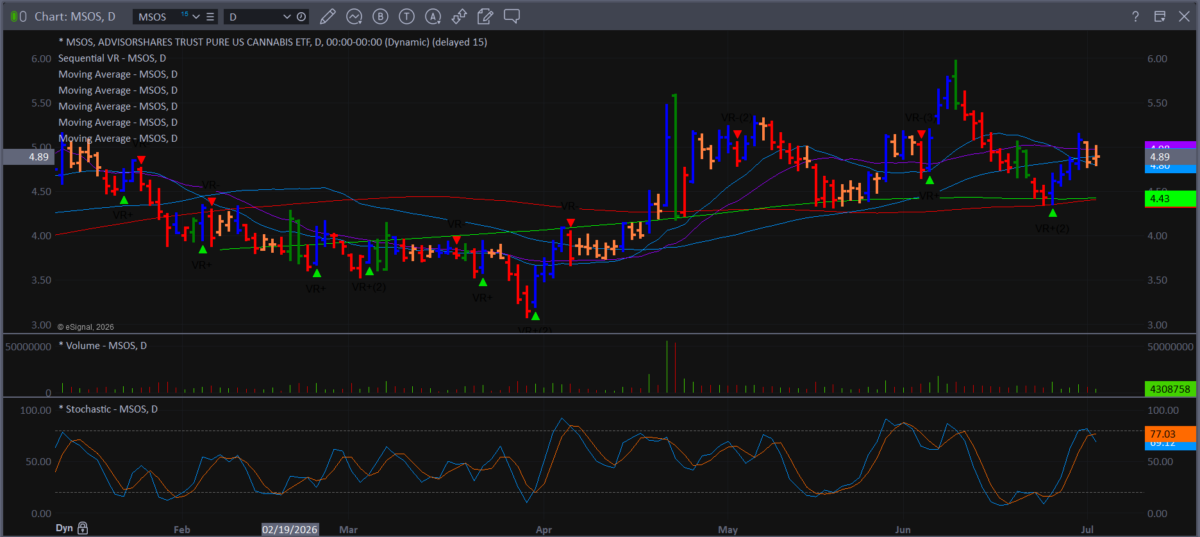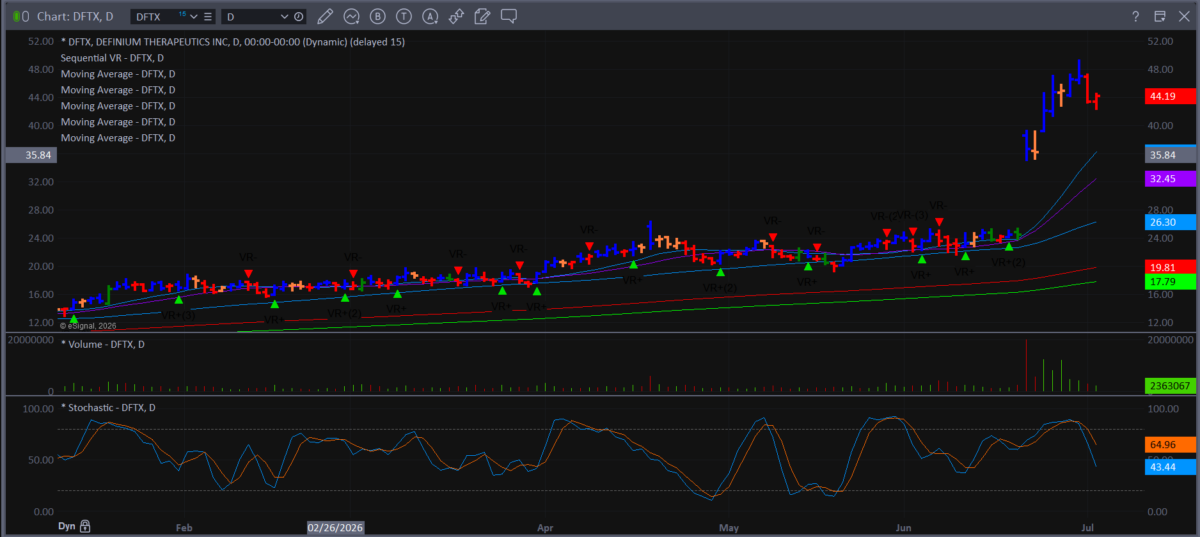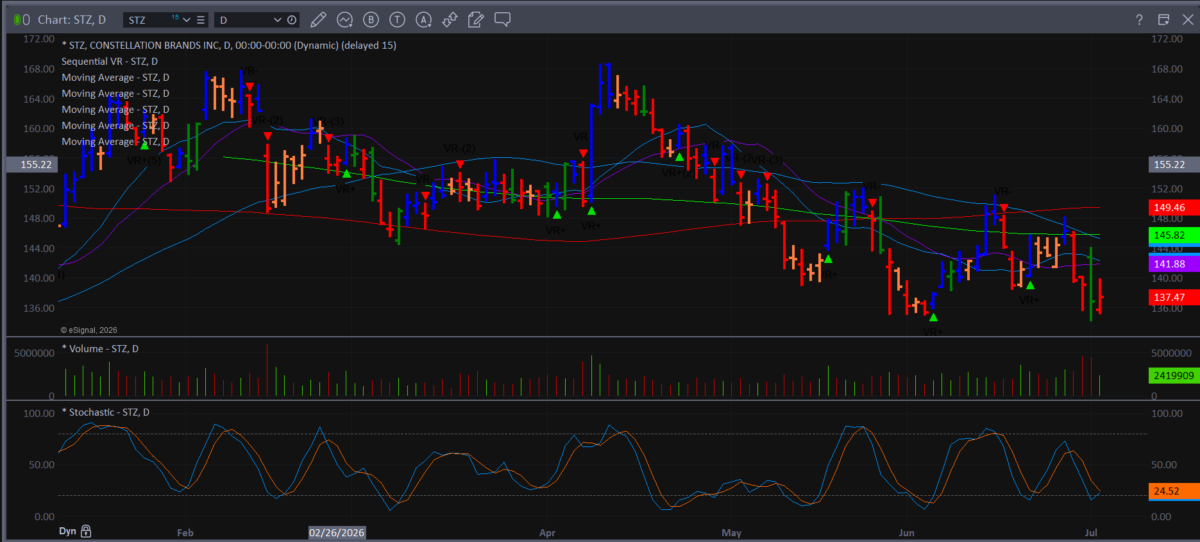


VR CANNA SECTOR WEEKLY LETTER- JULY 17-19, 2026

I AM AVAILABLE FOR TECHNICAL CONSULTATION ON THE VOLUME REVERSAL (TM) STRATEGY AND ACCOMPANYING TECHNICAL ANALYSIS.  CONTACT MARK.VRTRADER@GMAIL.COM

 

https://www.howestreet.com/2026/07/dow-transports-hit-record-high-mark-leibovit/

One interesting piece of Wall Street Week history is that my profile places me among a relatively small group of market technicians who achieved long-term national visibility through the show. Your biographies consistently note:

Seven years as a Wall Street Week Elf
More than thirty years as a Market Monitor guest on PBS’s Nightly Business Report
Two-time Timer Digest #1 market-timing recognition
Creator of the trademarked Volume Reversal Indicator.
/TOP THINGS TO KNOW
Senate Minority Leader Chuck Schumer (D-NY) and Sens. Cory Booker (D-NJ) and Ron Wyden (D-OR), along with other Democratic senators, filed a bill to federally legalize and tax marijuana while creating programs to aid people harmed by criminalization.
It would also prevent the federal recriminalization of hemp THC products that is scheduled to take effect in November.

Anti-marijuana groups and companies that are suing to block the Trump administration’s federal rescheduling proposal are asking a court not to allow medical cannabis businesses to intervene in the litigation—saying “they have not shown that the government will not adequately represent their interests in this case.”

Add Marijuana Moment As A Preferred Source On Google
Delaware’s marijuana commissioner is touting changes to cannabis policies that lawmakers passed this session, saying they will “further strengthen” the state’s regulatory framework—even as one measure was enacted despite the veto of the governor who appointed him.

Veterans Action Council’s Mary Lynn Mathre explains in a new Marijuana Moment op-ed how a seemingly innocuous cannabis question on a Department of Veterans Affairs dental form can affect veterans’ future medical care.

/ FEDERAL
Vice President JD Vance joked that Joe Rogan might need psychedelics after the podcast host quoted a news story about allegations that the U.S. conflict with Iran is intended to spur Biblical end times.

Health and Human Services Secretary Robert F. Kennedy Jr. tweeted, “America’s veterans deserve access to every safe and effective treatment modern medicine can offer. I joined @SecVetAffairs Doug Collins to launch a landmark partnership between @HHSgov and @DepVetAffairs to accelerate research into psychedelic therapies for veterans. We will follow the science, build the evidence, and move promising treatments forward for veterans living with PTSD, depression, and addiction. They served our country. Now it’s our duty to deliver the care they deserve.”

Rep. Wesley Hunt (R-TX) tweeted, “President Trump is RIGHT. Washington shouldn’t be picking winners and losers through special tax carveouts. If large cannabis companies want the benefits of full legalization, Congress should debate that openly, not quietly erase tax obligations through lobbyists behind closed doors.”

/ STATES
California Gov. Gavin Newsom (D) touted efforts to crack down on kratom and 7-OH products.

Nebraska Democratic gubernatorial candidate Lynne Walz, a former state senator, criticized officials for working to undermine voters’ approval of medical cannabis ballot initiatives.

A former Pennsylvania Superior Court judge authored an op-ed urging lawmakers not to legalize marijuana.

Missouri regulators are being sued over new hemp product restrictions.

Michigan regulators announced a recall of cannabis products that exceed THC potency limits.

Maine regulators are proposing technical changes to marijuana rules.

Rhode Island regulators published guidance on marijuana packaging and labeling requirements.

Ohio regulators published guidance about marijuana packaging seal requirements.

Massachusetts regulators are tracking localities that ban marijuana delivery services.

Washington State’s cannabis reporting system experienced technical issues.

The Maryland Cannabis Public Health Advisory Council met.

The Oklahoma Medical Marijuana Authority Advisory Council will meet on Friday.

The Colorado Retail Marijuana Public Health Advisory Committee will meet on Monday.

/ SCIENCE & HEALTH
A study found that “compared with no cannabis vaping or smoking, cannabis vaping only was not associated with respiratory symptoms, whereas cannabis smoking only and dual vaping and smoking were associated with increased odds.”

A review concluded that “psilocybin-assisted therapy represents a potentially transformative intervention” for major depressive disorder.

/ ADVOCACY, OPINION & ANALYSIS
The Albany Times Union editorial board said New York regulators need to do more to prevent use of marijuana by underage people.

/ BUSINESS
Eli Lilly and Company is acquiring AtaiBeckley Inc.

Organic Remedies is transitioning to an Employee Stock Ownership Plan.

Glass House Brands Inc. updated its at-the-market distribution program following its listing of shares on the New York Stock Exchange.


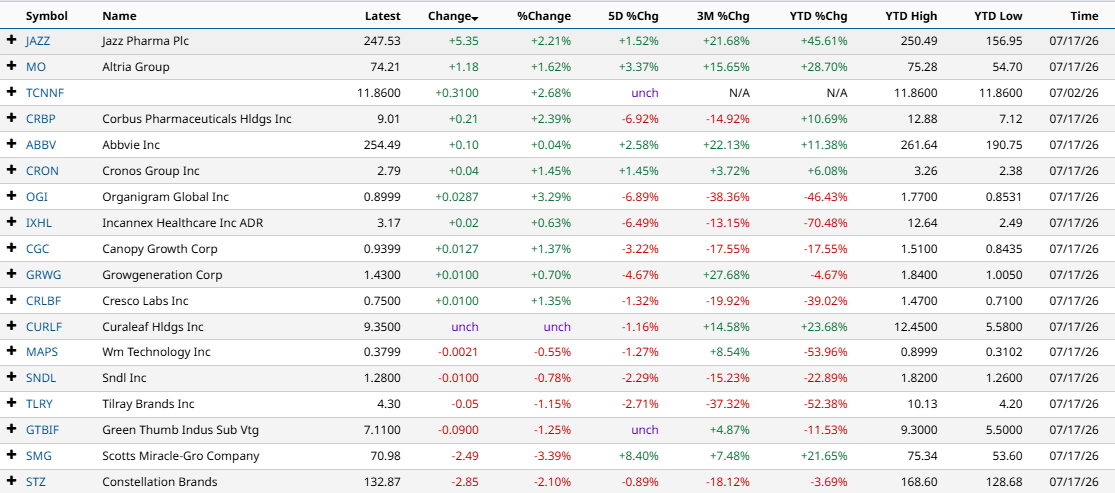
VR CANNA MOVERS FRIDAY,  JULY 17, 2026


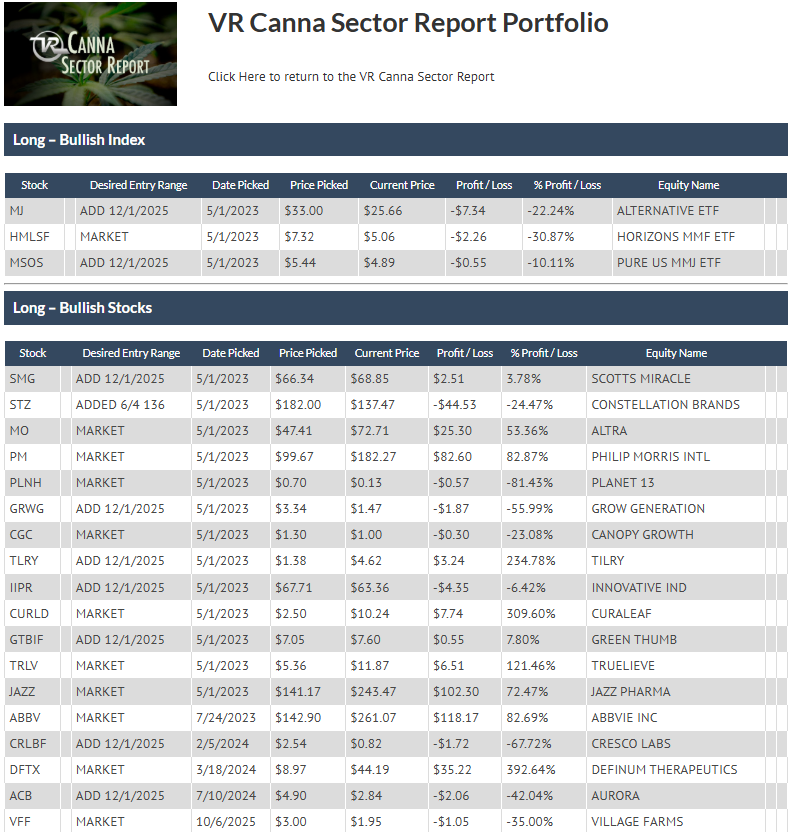
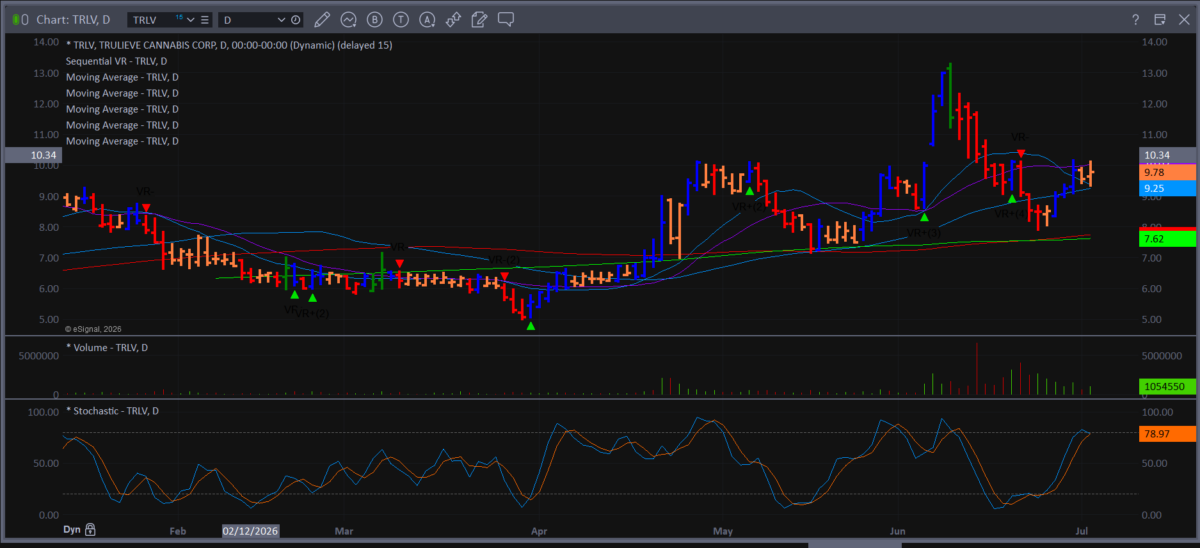
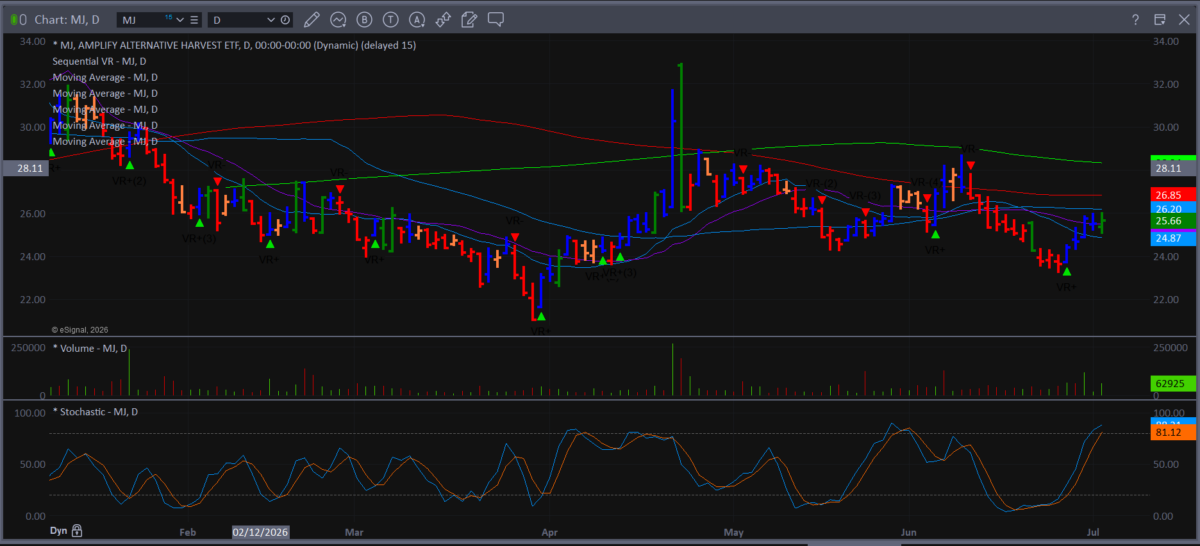
VR CHARTS

METASTOCK ADD-ON INDICATOR AVAILABLE AT METASTOCK.COM

https://www.metastock.com/products/thirdparty/?3pc-add-vris


ORDER LINK:

https://tinyurl.com/3tjv5up6


WHO IS MARK LEIBOVIT?

MARK LEIBOVIT is Chief Market Strategist for LEIBOVIT VR NEWSLETTERS a/k/a VRTrader.Com. His technical expertise is in overall market timing and stock selection based upon his proprietary VOLUME REVERSAL (TM) methodology and Annual Forecast Model.

Mark’s extensive media television profile includes seven years as a consultant ‘Elf’ on “Louis Rukeyser’s Wall Street Week” television program, and over thirty years as a Market Monitor guest for PBS “The Nightly Business Report”. He also has appeared on Fox Business News, CNBC, BNN (Canada), and Bloomberg, and has been interviewed in Barrons, Business Week, Forbes and The Wall Street Journal and Michael Campbell’s MoneyTalks.

In the January 2, 2020 edition of TIMER DIGEST MAGAZINE, Mark Leibovit was ranked the #1 U.S. Stock Market Timer and was previously ranked #1 Intermediate U.S. Market Timer for the ten year period December, 1997 to 2007.

He was a ‘Market Maker’ on the Chicago Board Options Exchange and the Midwest Options Exchange and then went on to work in the Research department of two Chicago based brokerage firms. Mr. Leibovit now publishes a series of newsletters at www.LeibovitVRNewsletters.com. He became a member of the Market Technicians Association in 1982.

Mr. Leibovit’s specialty is Volume Analysis and his proprietary Leibovit Volume Reversal Indicator is well known for forecasting accurate signals of trend direction and reversals in the equity, metals and futures markets. He has historical experience recognizing, bull and bear markets and signaling alerts prior to market crashes. His indicator is currently available on the Metastock platform.

His comprehensive study on Volume Analysis, The Trader’s Book of Volume published by McGraw-Hill is a definitive guide to volume trading. It is now also published in Chinese. Mark has appeared in speaking engagements and seminars in the U.S. and Canada.

DISCLAIMER:

WE ARE NOT FINANCIAL ADVISORS AND DO NOT PROVIDE FINANCIAL ADVICE

The website, LeibovitVRNewsletters.com, is published by LeibovitVRNewsletters LLC.

In using LeibovitVRnewsletters.com (a/k/a LeibovitVRNewsletters LLC) you agree to these Terms & Conditions governing the use of the service. These Terms & Conditions are subject to change without notice. We are publishers and are not registered as a broker-dealer or investment adviser either with the U.S. Securities and Exchange Commission or with any state securities authority.

All stocks and ETFs discussed are HYPOTHETICAL and not actual trades whose actual execution may differ markedly from prices posted on the website and in emails. This may be due internet connectivity, quote delays, data entry errors and other market conditions. Hypothetical or simulated performance results have certain inherent limitations as to liquidity and execution among other variables. PAST RESULTS ARE NOT NECESSARILY INDICATIVE OF FUTURE FORECASTING ACCURACY OR PROFITABLE TRADING RESULTS.

All investments are subject to risk, which should be considered on an individual basis before making any investment decision. We are not responsible for errors and omissions. These publications are intended solely for information and educational purposes only and the content within is not to be construed, under any circumstances, as an offer to buy or to sell or a solicitation to buy or sell or trade in any commodities or securities named within.

All commentary is provided for educational purposes only. This material is based upon information we consider reliable. However, accuracy is not guaranteed. Subscribers should always do their own investigation before investing in any security. Furthermore, you cannot be assured that your will profit or that any losses can or will be limited. It is important to know that no guarantee of any kind is implied nor possible where projections of future conditions in the markets are attempted.

Stocks and ETFs may be held by principals of LeibovitVRNewsletters LLC whose personal investment decisions including entry and exit points may differ from guidelines posted.

LeibovitVRNewsletters.com cannot and do not assess, verify or guarantee the suitability or profitability of any particular investment. You bear responsibility for your own investment research and decisions and should seek the advice of a qualified securities professional before making any investment. As an express condition of using this service and anytime after ending the service, you agree not to hold LeibovitVRNewsletters.com or any employees liable for trading losses, lost profits or other damages resulting from your use of information on the Site in any form (Web-based, email-based, or downloadable software), and you agree to indemnify and hold LeibovitVRNewsletters.com and its employees harmless from and against any and all claims, losses, liabilities, costs, and expenses (including but not limited to attorneys’ fees) arising from your violation of this agreement. This paragraph is not intended to limit rights available to you or to us that may be available under the federal securities laws.

For rights, permissions, subscription and customer service, contact the publisher at mark.vrtrader@gmail.com or call at 928-282-1275 or mail to 10632 N. Scottsdale Road B-426, Scottsdale, AZ 85254.

The Leibovit Volume Reversal, Volume Reversal and Leibovit VR are registered trademarks.

© Copyright 2026. All rights reserved.


https://tinyurl.com/3mn2rf7p
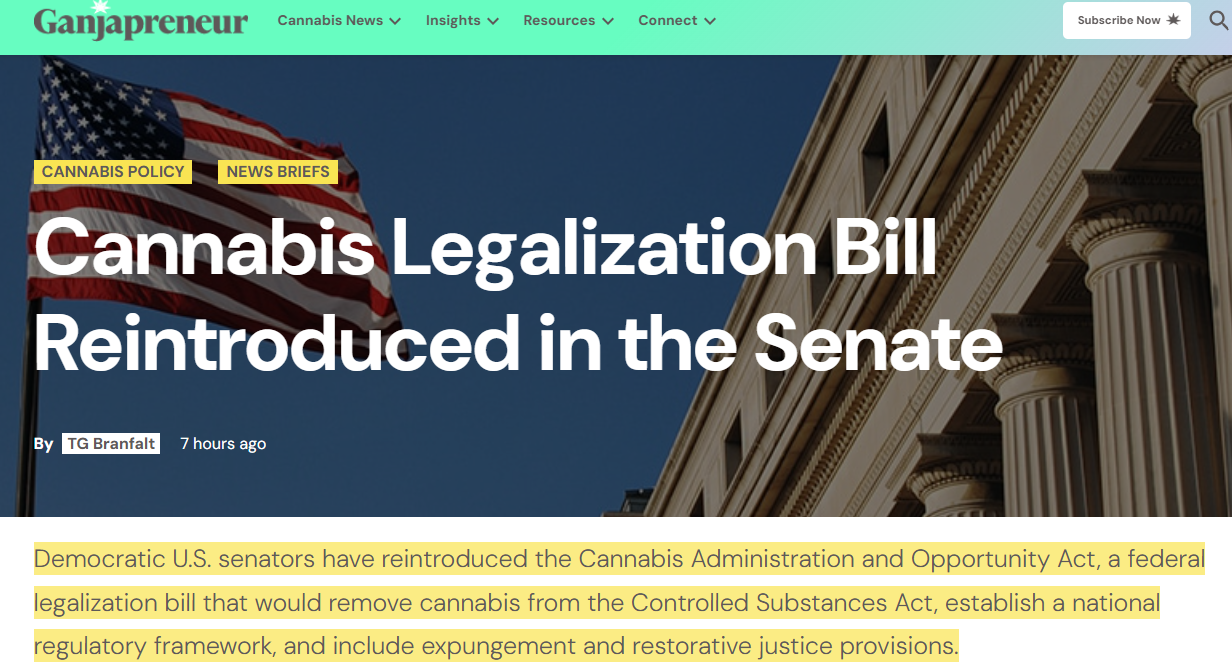
WHAT IS THE DIFFERENCE BETWEEN THE LEGISLATION PROPOSED BELOW AND WHAT WAS ACCOMPLISHED AND LEGALIZED IN CANADA? WE NEED TO MAKE CANNABIS FEDERALLY LEGAL TO WIPE OUT ANY BANKING OR OTHER STIGMAS THAT HAVE HELD THE INDUSTRY BACK MUCH WAS DONE IN CANADA?

This is the fundamental issue facing the U.S. cannabis industry today.

The legislation being debated in Congress (banking reforms, rescheduling, tax relief, etc.) is not the same as what Canada did in 2018.

Here’s the key distinction:

Canada (2018) Current U.S. proposals
✅ Cannabis legalized nationwide for adult use ❌ Cannabis still federally illegal
✅ Banks can freely lend Limited banking relief only
✅ Stock exchanges freely list cannabis companies Still many restrictions
✅ Federal taxes treated like any other business IRS 280E tax issue only partially addressed if rescheduled
✅ Interstate commerce legal Interstate commerce largely prohibited
✅ Institutional investors free to invest Many funds still avoid the sector
✅ Normal bankruptcy protection Complicated because of federal illegality

What Canada Actually Did

Canada passed the Cannabis Act in October 2018.

That law:

  • legalized recreational marijuana nationwide
  • legalized cultivation
  • legalized processing
  • legalized distribution
  • legalized retail sales (subject to provincial rules)
  • legalized banking
  • allowed pension funds and institutions to invest
  • allowed companies to list on the Toronto Stock Exchange and TSX Venture Exchange
  • removed nearly all federal criminal penalties

That is why companies like:

  • Canopy Growth
  • Tilray Brands
  • Aurora Cannabis

were able to become billion-dollar companies almost overnight.


The United States Today

The U.S. has a strange split system.

Approximately 40 states allow medical cannabis.

More than 20 allow recreational use.

Yet under federal law cannabis remains illegal (though federal enforcement policy has evolved).

This creates numerous problems:

  • banks hesitate to lend
  • payment processing is difficult
  • insurance costs are higher
  • companies cannot deduct ordinary business expenses under current federal tax rules tied to Schedule I status (the 280E issue)
  • interstate commerce is restricted
  • many institutional investors stay away
  • major U.S. exchanges generally do not list companies that directly violate federal law

SAFE Banking

SAFE Banking is a banking bill.

It does NOT legalize marijuana.

It simply says banks will not be penalized for serving state-legal cannabis businesses.

That helps:

  • loans
  • payroll
  • credit cards
  • armored cars
  • checking accounts

But nothing else changes.


Rescheduling

Moving cannabis from Schedule I to Schedule III would be significant because:

  • 280E tax penalties would largely disappear.
  • Research would become easier.
  • Physicians and scientists would face fewer regulatory hurdles.

However:

  • cannabis would still not be federally legal for adult use,
  • interstate commerce would remain limited,
  • many regulatory and investment issues would remain.

So Schedule III is helpful, but it is not legalization.


Full Federal Legalization

This is what many investors—including you—are referring to.

If Congress legalized cannabis nationally, many analysts believe it could trigger:

  • Massive institutional buying
  • NYSE and Nasdaq listings for more U.S. operators
  • Bank lending
  • Pension fund ownership
  • Mutual fund ownership
  • Interstate commerce
  • National brands
  • Mergers and acquisitions
  • Lower borrowing costs
  • Better valuations

The U.S. market is roughly 10 times larger than Canada’s, so the potential impact could be much greater.


Why Haven’t We Done What Canada Did?

The main reasons are political and constitutional.

Unlike Canada, U.S. states have developed very different cannabis laws, and Congress has not reached agreement on a single national framework. Debate continues over issues such as:

  • federal vs. state authority,
  • taxation,
  • impaired-driving standards,
  • public health,
  • criminal justice,
  • interstate commerce.

As a result, Congress has tended to consider narrower reforms (banking, research, rescheduling, tax issues) rather than comprehensive nationwide legalization.


My View of the Sector

Given your long-standing interest in cannabis investments like MSOS and U.S. multi-state operators, the biggest catalyst would still be full federal legalization. It would likely remove many of the structural obstacles that have constrained valuations for years.

That said, even without full legalization, a combination of:

  • Schedule III rescheduling,
  • banking reform,
  • and broader capital markets access

could materially improve profitability and investor interest. Full legalization would probably be a larger catalyst, but the magnitude and timing of any market reaction remain uncertain and would depend on the final legislation, regulations, company fundamentals, and broader market conditions.

If you’d like, I can also explain why Canadian cannabis stocks collapsed after legalization while many U.S. operators may have a different risk/reward profile today.

This is one of the most misunderstood stories in the cannabis sector. Canada proved that legalization alone does not guarantee investment success. The reasons Canadian cannabis stocks crashed are important because they also highlight why many investors believe the U.S. market could follow a different path.

Why Canadian Cannabis Stocks Collapsed

When Canada legalized cannabis in October 2018, investors assumed demand would be enormous and companies raced to build capacity.

Major producers such as:

  • Canopy Growth
  • Tilray Brands
  • Aurora Cannabis
  • Cronos Group

built huge greenhouses and borrowed heavily to finance expansion.

1. Massive Overproduction

Supply quickly exceeded demand.

Companies built enough capacity for a market that didn’t exist yet. Wholesale cannabis prices collapsed, inventories piled up, and many facilities had to be shut down.

2. Unrealistic Valuations

Some cannabis companies traded at extraordinary valuations despite having minimal revenue. Investors were paying for years of expected growth before it materialized.

When growth slowed, stock prices fell sharply.

3. Slower Retail Rollout

Provinces such as Ontario initially licensed relatively few retail stores, making legal access more limited than expected.

This delayed sales growth.

4. Black Market Competition

Legal cannabis carried taxes and regulatory costs that often made it more expensive than illicit products.

The illegal market remained a meaningful competitor for years.

5. Cash Burn

Many companies expanded aggressively, spending cash much faster than they generated it.

Eventually they had to:

  • issue additional shares,
  • take on debt,
  • sell assets,
  • or restructure operations.

Shareholders were diluted repeatedly.


Why the U.S. Could Be Different

This is where many investors see a different setup.

1. A Much Larger Market

Canada has about 40 million people.

The United States has about 340 million.

That alone creates a much larger potential customer base.

2. Existing Demand

Unlike Canada before legalization, many U.S. operators already have:

  • established brands,
  • cultivation facilities,
  • dispensaries,
  • operating cash flow in several cases.

Demand has already been demonstrated in many state markets.

3. Limited Supply Expansion

Many leading U.S. operators have generally expanded more cautiously than Canadian producers did in 2018.

Rather than building massive nationwide capacity before legalization, they have largely grown state by state.

4. Institutional Capital

If federal law changes, large investors that have largely stayed on the sidelines—mutual funds, pension funds, insurance companies, and many hedge funds—could gain greater ability to invest.

That could increase demand for shares, though the timing and scale would depend on the specific legislation and market conditions.


Why MSOS Could Benefit

The AdvisorShares MSOS ETF owns many of the largest U.S. multi-state operators, including companies such as:

  • Curaleaf Holdings
  • Green Thumb Industries
  • Trulieve Cannabis
  • Verano Holdings
  • Cresco Labs

Many of these companies already generate hundreds of millions of dollars in annual revenue. One of the biggest drags on profitability has been the federal tax treatment under Section 280E.

If cannabis is moved to Schedule III, many analysts expect a meaningful improvement in after-tax earnings because those companies could generally deduct ordinary business expenses for federal tax purposes.


A Possible Multi-Stage Revaluation

If reform continues to progress, the sector could see several distinct catalysts:

Stage 1 – Schedule III

  • Improved profitability from tax changes.
  • Better reported earnings.

Stage 2 – Banking Reform

  • Lower financing costs.
  • Easier access to loans and payment systems.

Stage 3 – Exchange Listings

  • Greater access to institutional investors if federal barriers are removed.
  • Increased trading liquidity.

Stage 4 – Federal Legalization

  • Interstate commerce.
  • National brands.
  • Consolidation through mergers and acquisitions.
  • Participation by large consumer packaged goods and pharmaceutical companies.

Could the Stocks Double?

History shows the sector can move dramatically in both directions.

Many leading U.S. cannabis stocks remain well below their 2021 highs, and if major federal reforms occur, large percentage gains are possible. However, there is no guarantee that prices will revisit previous peaks. Valuations will ultimately depend on profitability, competitive dynamics, regulation, and investor sentiment—not legalization alone.

If Congress legalizes cannabis without putting reasonable limits on large consumer companies entering the market, the long-term winners may not be today’s cannabis operators.

Companies such as Altria, Philip Morris International, Constellation Brands, or even major beverage and consumer packaged goods firms could use their capital, distribution networks, and marketing capabilities to gain market share.

That is why investors should pay attention not just to whether legalization happens, but how it is structured. The details of taxation, licensing, interstate commerce, and market access will play a major role in determining which companies ultimately benefit the most.

Many Democrats generally support legalization because they see it as:

  • Criminal justice reform (reducing arrests and convictions for marijuana offenses).
  • A states’ rights issue for states that have already legalized.
  • A source of tax revenue.
  • A public health issue that is better regulated than prohibited.
  • An economic development opportunity that creates jobs and businesses.

Many Democratic lawmakers also receive support from labor unions, social justice organizations, and, increasingly, businesses in the cannabis industry.


The Republican Coalition

Republicans are more divided.

Some support legalization based on:

  • individual liberty,
  • states’ rights,
  • free markets,
  • helping veterans access medical cannabis,
  • reducing federal regulation.

Others oppose it because of concerns about:

  • youth use,
  • impaired driving,
  • addiction,
  • public safety,
  • workplace safety,
  • federal drug policy.

So there isn’t a unified Republican position.


The Banking Issue

This is where many observers become frustrated.

Banks are federally regulated. Even if cannabis is legal under state law, many banks have been reluctant to provide services because marijuana remains illegal under federal law. That creates:

  • higher security risks from cash-heavy businesses,
  • higher compliance costs,
  • financing challenges.

Many people across the political spectrum argue that this is an inefficient outcome.


Why Not Just Legalize It?

Several reasons are commonly cited:

  1. Political leverage. A large, comprehensive bill can be broken into smaller pieces over multiple legislative sessions, allowing lawmakers to negotiate and claim incremental victories.
  2. Different priorities. Some members of Congress support banking reform but not full legalization. Others want social equity provisions included before supporting legalization. Others want broader criminal justice reforms tied to cannabis legislation.
  3. Federalism concerns. Congress must decide how federal legalization would interact with states that choose to keep marijuana illegal.
  4. Regulatory questions. Congress would need to determine:
    • who regulates cannabis,
    • taxation,
    • advertising rules,
    • interstate commerce,
    • product safety standards.

Large Industries Also Have Interests

Several industries could be affected by legalization, including:

  • alcohol,
  • tobacco,
  • pharmaceuticals,
  • private prisons,
  • law enforcement equipment,
  • agriculture,
  • banking.

It is reasonable to expect companies in these sectors to advocate for policies that align with their business interests. That is common across many areas of public policy. However, it is difficult to demonstrate that any one industry alone explains the pace or outcome of federal cannabis legislation.

Assessment

The biggest obstacle today is probably not whether cannabis will eventually receive broader federal reform, but what form that reform takes.

The debate includes questions such as:

  • Should there be national legalization?
  • Should states remain free to prohibit it?
  • Should large corporations be allowed to dominate the market?
  • How should cannabis be taxed?
  • Should past federal convictions be addressed?
  • Which federal agencies should oversee the industry?

Those questions create unusual political coalitions, where lawmakers who agree on one aspect (such as banking) may strongly disagree on others (such as nationwide legalization or social equity provisions).

[/fusion_text][/fusion_builder_column][/fusion_builder_row][/fusion_builder_container]

By |2026-07-17T22:38:42-07:00July 17th, 2026|Uncategorized|0 Comments

Share This Story, Choose Your Platform!

Go to Top