
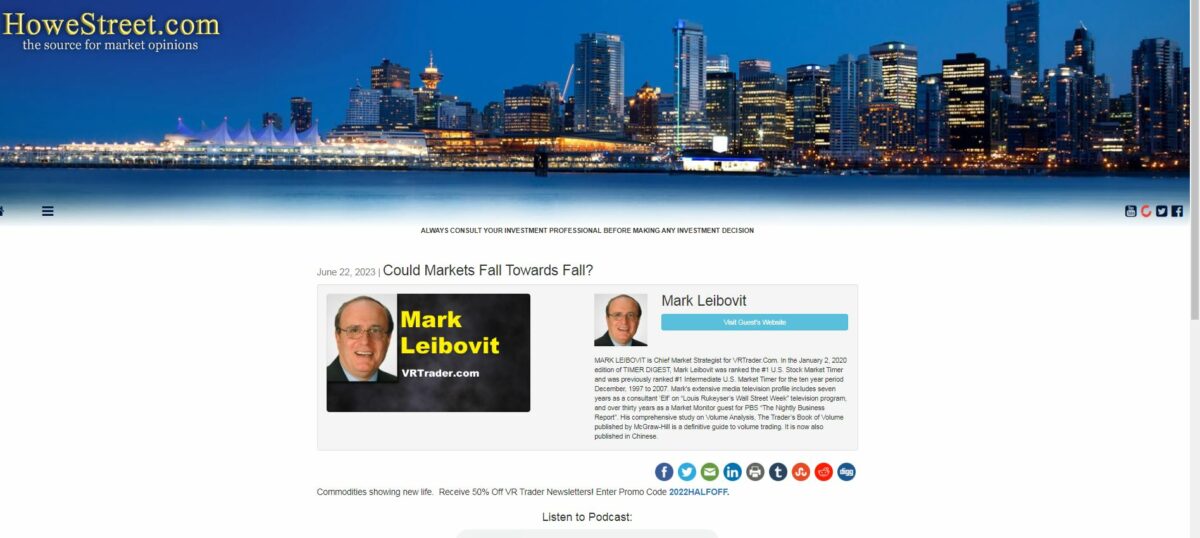
WHO IS MARK LEIBOVIT?

MARK LEIBOVIT is Chief Market Strategist for LEIBOVIT VR NEWSLETTERS a/k/a VRTrader.Com. His technical expertise is in overall market timing and stock selection based upon his proprietary VOLUME REVERSAL (TM) methodology and Annual Forecast Model.
Mark’s extensive media television profile includes seven years as a consultant ‘Elf’ on “Louis Rukeyser’s Wall Street Week” television program, and over thirty years as a Market Monitor guest for PBS “The Nightly Business Report”. He also has appeared on Fox Business News, CNBC, BNN (Canada), and Bloomberg, and has been interviewed in Barrons, Business Week, Forbes and The Wall Street Journal and Michael Campbell’s MoneyTalks.

In the January 2, 2020 edition of TIMER DIGEST MAGAZINE, Mark Leibovit was ranked the #1 U.S. Stock Market Timer and was previously ranked #1 Intermediate U.S. Market Timer for the ten year period December, 1997 to 2007.
He was a ‘Market Maker’ on the Chicago Board Options Exchange and the Midwest Options Exchange and then went on to work in the Research department of two Chicago based brokerage firms. Mr. Leibovit now publishes a series of newsletters at www.LeibovitVRNewsletters.com. He became a member of the Market Technicians Association in 1982.
Mr. Leibovit’s specialty is Volume Analysis and his proprietary Leibovit Volume Reversal Indicator is well known for forecasting accurate signals of trend direction and reversals in the equity, metals and futures markets. He has historical experience recognizing, bull and bear markets and signaling alerts prior to market crashes. His indicator is currently available on the Metastock, and TradeStation platforms.
His comprehensive study on Volume Analysis, The Trader’s Book of Volume published by McGraw-Hill is a definitive guide to volume trading. It is now also published in Chinese. Mark has appeared in speaking engagements and seminars in the U.S. and Canada.
https://tinyurl.com/5n8cn257
OPPORTUNITY TO ACCESS MARK LEIBOVIT’S PROPRIETARY VOLUME REVERSAL INDICATOR – THIS IS THE ONLY PLACE TO DO IT!

https://www.metastock.com/products/thirdparty/?3PC-ADD-VRIS

THE VR FORECASTER 2022 AFM BELOW

https://tinyurl.com/edav6erv
SIGN UP FOR THE 2023 AFM ABOVE



WHEN THE PEOPLE FEAR THE GOVERNMENT THERE IS TYRANNY!
WHEN THE GOVERNMENT FEARS THE PEOPLE THERE IS LIBERTY!

https://tinyurl.com/2fxs42h5
FROM 2007 – REP RON PAUL:

IT IS TIME TO REPEAL THE 16TH AMENDMENT – THE ONE THAT CREATES INCOME TAX

THE CASE FOR ABOLISHING THE FEDERAL RESERVE


This Economic Indicator Has Flawlessly Predicted Directional Stock Movements for 70 Years. Here’s What It Says Happens Next
https://tinyurl.com/yus6nbdv

Mexico’s Popocetepeti volcano erupts
https://www.wsj.com/story/photos-show-mexicos-popocatepetl-volcano-spewing-ash-and-smoke-5eb8ae3f

A recession indicator that predicted every downturn since 1969 started flashing months ago—and a Wall Street veteran warns it always works on a delay -Yahoo! Finance
Will we officially be in a recession by October? All indicators point to ‘yes’. It’s hard to ignore the signs of a downtrend ahead any longer. The best preparation? A well diversified portfolio including tangible assets, like precious metals; and a healthy dose of hope and patience while weathering the storm.
by Will Daniel
Wall Street analysts and investment strategists love to use “recession indicators.” These simple statistics that serve as evidence of (potential) impending economic disaster can be invaluable tools for managing risk. Just look at one of the most famous of them all: the yield curve. Since 1969, a yield curve inversion has preceded every U.S. recession.
The yield curve is a graphical representation of the relationship between the yields of related bonds—most commonly the U.S. 10-year Treasury and two-year Treasury. Typically, shorter-term bonds have lower yields than longer-term bonds because investors are taking more risk by locking up their money for longer. This relationship is represented by an upward sloping curve. But sometimes that yield curve can invert, meaning long-term bond yields drop below short-term bond yields.
Megan Horneman, chief investment officer at Verdence Capital Advisors, warned Monday that even after nearly a year, investors shouldn’t be “complacent” about this “historical recession indicator.”
The Fed’s “One Weird Trick” -Daily Reckoning
We have all seen the “wealth effect” discussed in this article on full display over the last couple of years. Debt-based consumption was easy and cheap. Why not get a newer car/bigger house/RV or boat? But those days are coming to an end and the consequences are headed our way. The bubbles created by low-cost credit are near bursting and the Fed no longer has any tricks up its sleeve.
by Charles Hugh Smith – Of Two Minds blog
The U.S. economy has been saved time and again over the past two decades by this one weird trick:
“Bringing Demand Forward” by lowering interest rates and lending standards so Americans could continue to buy stuff they didn’t really need because the monthly payment dropped as interest rates were pushed toward zero.
Every time the economy faltered, the Federal Reserve would push interest rates down to “Bring Demand Forward” by goosing debt-based consumption: OK, so you don’t actually need a new car, but come on, the new car loan is only 1.9%, you can afford the monthly nut.
Or hey, it’s zero-percent financing for a couple years. Just go for it, get that new vehicle. Live large, you can swing it.
Flooding the economy with low-cost credit doesn’t just “Bring Demand Forward”; it also juices speculative bubbles across the entire spectrum, from cryptocurrencies to commercial real estate. R
How long will the dollar last as the world’s default currency? The BRICS nations are gathering in South Africa this August with it on the agenda -Fortune
Could a new global currency really challenge the dollar’s role in the global economy? It seems farfetched but a joint BRICS currency may just have the power to unseat King Dollar.
by Mihaela Papa and The Conversation
Could a new currency be set to challenge the dominance of the dollar? Perhaps, but that may not be the point.
In August 2023, South Africa will host the leaders of Brazil, Russia, India, China and South Africa – a group of nations known by the acronym BRICS. Among the items on the agenda is the creation of a new joint BRICS currency.
As a scholar who has studied the BRICS countries for over a decade, I can certainly see why talk of a BRICS currency is, well, gaining currency. The BRICS summit comes as countries across the world are confronting a changing geopolitical landscape that is challenging the traditional dominance of the West. And while the BRICS countries have been seeking to reduce their reliance on the dollar for over a decade, Western sanctions on Russia after its invasion of Ukraine have accelerated the process.
Banks face their worst losses since the 2008 crisis if inflation cannot be tamed, says the world’s brain trust of central bankers -Yahoo!Finance
by Christiaan Hetzner
The banking crisis sparked by the collapse of three major U.S. lenders in the spring may be out of the headlines, but it’s not over.
The normally staid economists at the Bank for International Settlements, a type of brain trust for the world’s fiat-based monetary system, is not a group prone to employing alarmist language.
Yet officials called for an urgent “change in mindset” among advanced economies now that the limits of Keynesian-style expansion fueled by debt has been exhausted.
“The global economy is at a critical juncture,” said [sic] BIS general manager Agustín Carstens told journalists on Sunday during the presentation of its annual report.
A toxic mixture of soaring inflation not seen since at least the 1970s, as well as historically high public and private debt, cannot be sustained for much longer.
Corporate bankruptcies and defaults are surging – here’s why -CNBC
by Lillian Rizzo
The Federal Reserve plans to keep hiking interest rates to stem inflation, which means an increase in corporate default rates is likely in coming months.
The corporate default rate rose in May, a sign that U.S. companies are grappling with higher interest rates that make it more expensive to refinance debt as well as an uncertain economic outlook.
There have been 41 defaults in the U.S. and one in Canada so far this year, the most in any region globally and more than double the same period in 2022, according to Moody’s Investors Service.
Earlier this week, Fed Chairman Jerome Powell said to expect more interest rate increases this year, albeit at a slower rate, until more progress is made on lowering inflation.
Bankers and analysts say high interest rates are the biggest culprit of distress. Companies that are either in need of more liquidity or those that already have hefty debt loads in need of refinancing are faced with a high cost of new debt.
We may be seeing the formation of a bubble in the stock market like no other -The Globe and Mail
by George Athanassakos
Back in 1923, writer and journalist Edwin Lefevre wrote, “Nowhere does history indulge in repetitions so often or so uniformly as in Wall Street. When you read contemporary accounts of booms or panics, the one thing that strikes you most forcibly is how little either stock speculation or stock speculators today differ from yesterday. The game does not change and neither does human nature.”
The S&P 500 has been on a tear since the beginning of the year and recently it entered bull-market territory. But if you exclude the U.S.’s seven largest tech stocks, which were up more than 53 per cent year to date, the S&P 500 was mostly flat over the period.
Many wonder whether we have we seen this movie before and whether another bubble is being formed, one that will target the most profitable U.S. tech stocks. For the first time in the last 40 years, we may be witnessing a bubble forming around highly profitable companies, as opposed to prior bubbles that were centred on unprofitable ones. It has happened before, though, involving the 50 large-cap/blue chip stocks on the New York Stock Exchange, which in the 1960s propelled the bull market higher and subsequently crashed and underperformed.
$572,000,000,000 Added to US Debt in Two Weeks, Total Debt Now Exceeds China, Japan, Germany and UK’s Combined GDP – The Daily Hodl
by Alex Richardson
Over half a trillion more dollars have been dumped into the US government’s debt spiral in the last two weeks alone.
According to the latest numbers from FiscalData, as of June 15th, the US national debt was $32.03 trillion, a $571 billion rise from June 1st’s recording of $31.46 trillion.
Total US debt is now larger than the total gross domestic product of China, Japan, Germany and the United Kingdom combined, and amounts to $244,000 per American household.
At current interest rates, the US is now paying over $2 billion a day in interest payments, and even if every American household contributed $1,000 a month to pay off the debt, it would still take 20 years to pay off.
While the US’ debt issue has received increased attention from both analysts and regular Americans, most experts still expect the problem to intensify over the next decade.
https://tinyurl.com/4subts7j
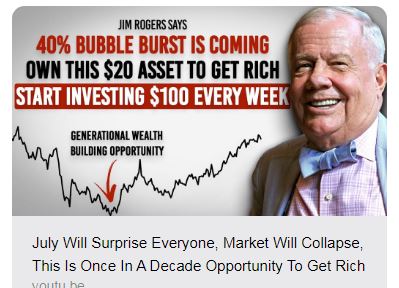
Coming Wall Street crash biggest in a lifetime!
“[In] 2008, we had a bear market because of too much debt,” says legendary investor Jim Rogers. “Look out the window since 2008, debt
everywhere has skyrocketed.”
“It’s a simple statement that the next bear market will be the worst in my lifetime because the debt has gone up by such staggering
amounts in the past 14 years.”
It’s been a while since we checked in with Jim Rogers, but he is an informed and often prescient voice. During the brutal bear market
of the 1970s, the Quantum Fund, which Rogers co-founded, beat the S&P by an incredible 4,150 percent, making it one of the best-
performing hedge funds ever.
Since there is no substitute for up-close and personal real-life experience, Jim Rogers has twice driven around the world, once by
motorcycle, crossing primitive frontiers and backwater boundaries in search of investment opportunities.
It has been a long time – too long – since we last wrote about Jim’s outlook. In fact, last time we did, the national debt was only $22
trillion. Now it’s about $10 trillion higher, with the statutory debt limit being raised again. (If nothing else, we need to be aware
that things are moving fast… very fast).
Back then, Jim was saying that things in America peaked out in about the year 2000. “Since then,” he says, “with Dubya’s $5 trillion
war against Iraq… Obamacare… quantitative easing and a negative real fed funds rate for 10 years… transgenderism, the Kardashians, Lee
Greenwood, trillion-dollar deficits, $22 trillion in federal debt, fake money, fake interest rates, and fake wars – it has been all
downhill.”
Speaking to a group of fund managers in May, Rogers addressed the debt crisis, foreseeing trouble for both the country and the dollar:
“Every country in history that’s gotten into this situation has had serious problems eventually,” the investment veteran said. “And we
will, too.”
“You should be extremely worried because if you’re not, you don’t know what’s going on,” he warned. “Many countries are starting to look
for alternatives to the U.S. dollar, partly because of its horrendous debt problem.”
Jim Rogers is a gold and silver investor himself. “The best place to be when you have inflation is real assets, and real assets are
commodities,” he said.
https://tinyurl.com/3t9a8229
Soros Fund Management Chief Executive Says Additional Banks Will Fail: ‘There Are More Problems Under The Surface’
Dawn Fitzpatrick, the chief executive of the $5.61 billion private investment firm Soros Fund Management, says the crisis in the U.S. banking sector is not yet over, and more failures are on the way.
In an interview with Bloomberg, Fitzpatrick said that additional bank failures are on the horizon, citing ongoing concerns and warning signs within the troubled banking sector.
“I think you are going to see more bank failures, likely in the small banks. So it’s not going to be the big headlines and the size of the failures we had so far. But I think there are more problems under the surface,” she said.
“The Federal Reserve has said they’re doing a comprehensive review of bank regulation. I think what that’s going to look like is enhanced stress test, AOCI (accumulated other comprehensive income) exemptions I think are going to disappear. That’s [when] people did not have to mark things to market,” Fitzpatrick added.
https://tinyurl.com/22a7bfvm


Will an electromagnetic pulse (EMP) big enough to knock out all power in the US ever come? Most definitely. Will it actually put us in total-nation blackout? It depends on who you ask.
An EMP is a pulse of energy caused by the interaction between charged particles.
An EMP is an “electromagnetic pulse” and comes from one of the four fundamental forces of nature: electromagnetism. In a nutshell, electromagnetism is the interaction between charged particles that create electricity (the flow of electric charges) and magnetism (the force that attracts objects or pushes them away).
With this in mind, an EMP is when a short, intense burst of one of these energies occurs. Imagine a quick electrical surge, and you get the picture.
How Do EMPs Affect Humans?
EMPs generally have little direct effect on the human body, though recent research is showing that certain types of EMP exposure might cause issues in the nervous system and the brain.
How Do EMPs Affect Electronics?
The big concern with EMPs is the way they impact electronics. The same way lightning hitting your house can fry your power sockets, an EMP pushes more energy into the wiring and chips of power stations and electronic devices than they were built to handle, doing irreparable damage like: Coupling. Causing different parts of electronics to couple (a metallic wire and optical fiber, for example) in ways they weren’t meant to. Short Circuits. Interrupting the intended path of an electric current and causing systemic shutdown. Serious Physical Damage. Overloading physical components like wires, causing them to overheat and fuse together.
Three power grids run most energy in the United States
It’s well known (both to us and our enemies) that the US electric grid is highly vulnerable. There are only three grids that interconnect to run most all of America’s power: The Eastern Grid, the Western Grid, and the Texas (ERCOT) Grid. That’s a lot of eggs in very few baskets.
As far back as 2012, the National Research Council found that the current configuration, with its outdated infrastructure and operational protocol, makes our power grid a sitting duck to what’s called “cascading failures”—a domino-like collapse that could take out an entire power grid.
Here’s how that would happen: A massive EMP would overload a section of the grid. That section would collapse, and as a safety measure automatically shift the extra load to another section. That second section would then collapse and pass on the energy. In little time, most or all of the grid could be fried.
As Daniel Baker, physicist at the University of Colorado puts it, once these components are destroyed, “you can’t exactly buy another at Sears.”
The damage could take months or years to replace, leaving hundreds of millions of people (or even the entire country) in an indefinite blackout. It would be like living in the 1800s without any of the old-fashioned resources or know-how to survive.
Where Do EMPS Come From?
EMP sources include lightening, earthquakes, volcanoes, and nuclear detonation, solar.
NATURAL SOURCES FROM THE EARTH
Having said that, not all EMPs are necessarily capable of the same levels of damage. The impact would vary depending on the source.
For example, the earth is regularly hit by EMPs from earthquakes, volcanoes, and lightning—with little to no backlash.
When it comes to massive, earth-shattering events, the two sources most experts worry about are nuclear and solar EMPs. Here’s what we could expect from each.
NUCLEAR
When you think of a nuclear bomb, you probably imagine a mushroom cloud, blast wave, and radiation.
One effect that’s gotten less attention until recently, though, is the EMP triggered by a nuclear detonation—a mix of gamma rays and air molecules that send electromagnetic radiation corkscrewing through the atmosphere.
Some experts estimate a nuclear EMP could shut down massive sections of the power grid for miles around the blast and trigger that “1800s-style” blackout.
One of the most vocal of these is Dr. Peter Pry, executive director of the EMP Task Force on National and Homeland Security. A few years ago, he testified before Congress that such a worst-case scenario could potentially wipe out 90% of the population through starvation, disease, and societal collapse.
Before we start running for our bunkers, though, groups like the Electric Power Research Institute (EPRI) are convinced that the damage from a nuclear EMP wouldn’t be nearly so apocalyptic. Simple mitigation measures should prevent most of the damage.
Others point out that even though China, Russia, North Korea, and Iran have reportedly been working on weaponizing EMPs, they would probably never use them. The same sense of “mutually assured destruction” that’s prevented nuclear war for generations would also
prevent an all-out EMP attack.
SOLAR FLARE EMP
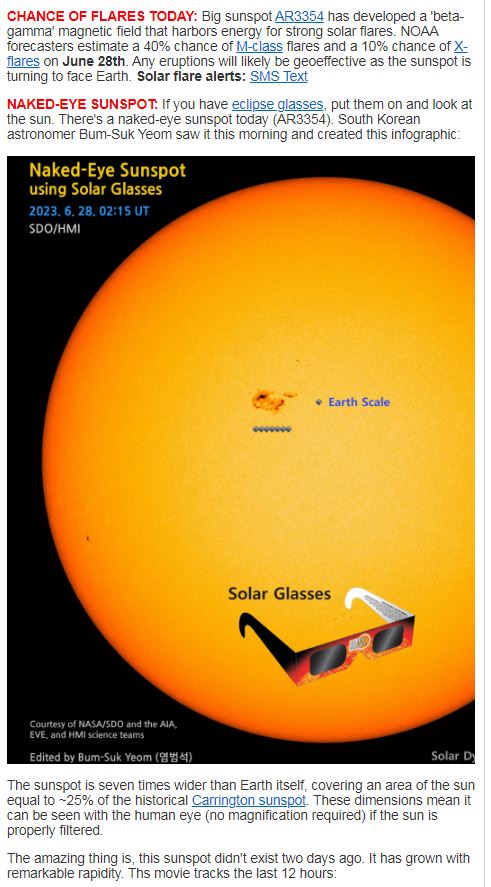
The most concerning source of EMPs are massive coronal ejections from the sun.
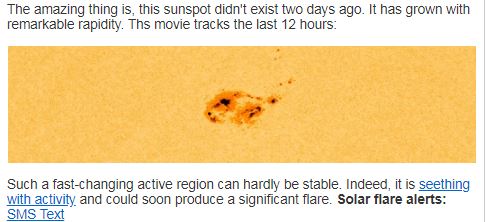
Like clockwork, our amazing sun is on an 11-year cycle of fluctuating sunspot (cool areas) and solar flare (explosions of energy) activity—sometimes up, sometimes down. The peaks in activity are called “solar maximum” periods and the troughs are called “solar minimums.”
During solar maximums, the sun produces about three massive solar flares per day, called “Coronal Mass Ejections (CMEs). These events rarely do any harm here on earth, but, under the right conditions, a large enough mass ejection from the sun would create an EMP that wreaked total havoc on just about anything running on electricity.
For perspective, the last time this happened was in 1859, in a famous incident called the Carrington Event where a massive CME caused telegraph systems all over the North America and Europe to fail.
Nuclear Vs. Solar: Which Is a Bigger Threat?
So, which type of EMP event should concern you most? If you’re in a proper prepping state of mind, the answer is both. But all told, a solar EMP is the more threatening of the two, if for no other reason than pure inevitability.
The sophistication, expense, and will needed to pull off a nuclear EMP attack is borderline prohibitive. First you have to get a nuke. Then the nuke has to be carried or otherwise propelled about 20 miles into the upper atmosphere—three to four times higher than a commercial jet. At that point, it would have to be detonated, probably remotely, in the right location.
All in all, a tough job, and one that only a handful of sovereign nations could handle. Add to that the fact that such an act would likely usher in World War 3, and there are plenty of natural deterrents.
A solar EMP, on the other hand, is inevitable. It costs nothing and requires no special effort other than just waiting. The sun produces CMEs almost every day and at some point one of those ejections is going to be big enough to blast earth with a massive, destructive EMP. It’s not a matter of if, but when.
Why Are EMPs So Dangerous—Possible Scenarios
It doesn’t take a huge stretch of the imagination to see how an EMP could devastate a modern city. Airports, hospitals, banks, water, food—just about every aspect of our lives depends on electricity to operate. An EMP has the potential to take them all out at once, and to keep them out for weeks or months.
Here are a few of the most concerning scenarios a massive EMP could put us in. Keep in mind, these are worst-case scenarios. Things may never get this bad but it’s prudent to be prepared for the worst, either way.
DISCLAIMER:
WE ARE NOT FINANCIAL ADVISORS AND DO NOT PROVIDE FINANCIAL ADVICE
The website, LeibovitVRNewsletters.com, is published by LeibovitVRNewsletters LLC.
In using LeibovitVRnewsletters.com (a/k/a LeibovitVRNewsletters LLC) you agree to these Terms & Conditions governing the use of the service. These Terms & Conditions are subject to change without notice. We are publishers and are not registered as a broker-dealer or investment adviser either with the U.S. Securities and Exchange Commission or with any state securities authority.
All stocks and ETFs discussed are HYPOTHETICAL and not actual trades whose actual execution may differ markedly from prices posted on the website and in emails. This may be due internet connectivity, quote delays, data entry errors and other market conditions. Hypothetical or simulated performance results have certain inherent limitations as to liquidity and execution among other variables. PAST RESULTS ARE NOT NECESSARILY INDICATIVE OF FUTURE FORECASTING ACCURACY OR PROFITABLE TRADING RESULTS.
All investments are subject to risk, which should be considered on an individual basis before making any investment decision. We are not responsible for errors and omissions. These publications are intended solely for information and educational purposes only and the content within is not to be construed, under any circumstances, as an offer to buy or to sell or a solicitation to buy or sell or trade in any commodities or securities named within.
All commentary is provided for educational purposes only. This material is based upon information we consider reliable. However, accuracy is not guaranteed. Subscribers should always do their own investigation before investing in any security. Furthermore, you cannot be assured that your will profit or that any losses can or will be limited. It is important to know that no guarantee of any kind is implied nor possible where projections of future conditions in the markets are attempted.
Stocks and ETFs may be held by principals of LeibovitVRNewsletters LLC whose personal investment decisions including entry and exit points may differ from guidelines posted.
LeibovitVRNewsletters.com cannot and do not assess, verify or guarantee the suitability or profitability of any particular investment. You bear responsibility for your own investment research and decisions and should seek the advice of a qualified securities professional before making any investment. As an express condition of using this service and anytime after ending the service, you agree not to hold LeibovitVRNewsletters.com or any employees liable for trading losses, lost profits or other damages resulting from your use of information on the Site in any form (Web-based, email-based, or downloadable software), and you agree to indemnify and hold LeibovitVRNewsletters.com and its employees harmless from and against any and all claims, losses, liabilities, costs, and expenses (including but not limited to attorneys’ fees) arising from your violation of this agreement. This paragraph is not intended to limit rights available to you or to us that may be available under the federal securities laws.
For rights, permissions, subscription and customer service, contact the publisher at mark.vrtrader@gmail.com or call at 928-282-1275 or mail to 10632 N. Scottsdale Road B-426, Scottsdale, AZ 85254.
The Leibovit Volume Reversal, Volume Reversal and Leibovit VR are registered trademarks.
© Copyright 2023. All rights reserved.