

https://www.howestreet.com/2024/11/even-with-trump-stock-markets-will-make-corrections-mark-leibovit/

Inflation is not caused by the actions of private citizens, but by the government: by an artificial expansion of the money supply required to support deficit spending. No private embezzlers or bank robbers in history have ever plundered people’s savings on a scale comparable to the plunder perpetrated by the fiscal policies of statist governments.
~ Ayn Rand
After showing a lack of direction for much of the session, stocks came under pressure in the latter part of the trading day on Thursday. The major averages slid more firmly into negative territory after spending most of the day bouncing back and forth across the unchanged line.
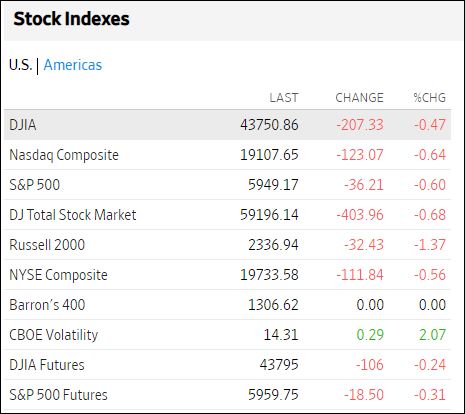
The major averages ended the day just off their lows of the session. The Dow slid 207.33 points or 0.5 percent to 43,750.86, the Nasdaq fell 123.07 points or 0.6 percent to 19,107.65 and the S&P 500 declined 36.21 points or 0.6 percent to 5,949.17.
The weakness that emerged on Wall Street late in the session came after Federal Reserve Chair Jerome Powell said the central bank does not “need to be in a hurry to lower rates” due to the strength of the economy.
“The economy is not sending any signals that we need to be in a hurry to lower rates,” Powell said during an event in Dallas, Texas. “The strength we are currently seeing in the economy gives us the ability to approach our decisions carefully.”
Powell’s comments on the outlook for rates came as he described the U.S. economy’s performance as “remarkably good,” noting the labor market remains in solid condition but is no longer a source of significant inflationary pressures.
He also said the Fed is attentive to risks to both its employment and inflation goals, noting cutting rates too quickly could hinder progress on inflation but cutting rates too slowly could unduly weaken economic activity and employment.
“We are moving policy over time to a more neutral setting. But the path for getting there is not preset,” Powell said. “Ultimately, the path of the policy rate will depend on how the incoming data and the economic outlook evolve.”
Powell’s remarks came as the latest batch of U.S. economy data released earlier in the day generated some uncertainty about the outlook for interest rates.
The Labor Department released a report this morning showing first-time claims for U.S. unemployment benefits unexpectedly edged lower in the week ended November 9th.
The report said initial jobless claims slipped to 217,000, a decrease of 4,000 from the previous week’s unrevised level of 221,000. Economists had expected jobless claims to inch up to 223,000.
The unexpected decline pulled jobless claims down to their lowest level since hitting 216,000 in the week ended May 18th.
After yesterday’s consumer price inflation data matched expectations, the Labor Department also released a separate report showing producer prices in the U.S. also increased in line with economist estimates in the month of October.
The Labor Department said its producer price index for final demand rose by 0.2 percent in October following a revised 0.1 percent uptick in September.
Meanwhile, the report said the annual rate of growth by producer prices accelerated to 2.4 percent in October from an upwardly revised 1.9 percent in September.
The annual rate of producer price growth was expected to accelerate to 2.3 percent from the 1.8 percent originally reported for the previous month.
The slightly faster than expected annual price growth combined with the jobless claims data showing continued strength in the labor market has added to recent uncertainty about the outlook for interest rates.
While the Fed is still widely expected to lower interest rates by a quarter point next month, there is some concern sticky inflation will lead the central bank to slow the pace of its rate cuts in early 2025.
Sector News
Biotechnology stocks moved sharply lower over the course of the session, dragging the NYSE Arca Biotechnology Index down by 2.8 percent.
Significant weakness also emerged among healthcare and pharmaceutical stocks, with the Dow Jones U.S. Health Care Index and the NYSE Arca Pharmaceutical Index falling by 1.6 percent and 1.5 percent, respectively.
Networking, steel and commercial real estate stocks also showed notable moves to the downside, while considerable strength remained visible among airline stocks.
Reflecting the strength in the airline sector, the NYSE Arca Airline Index jumped by 1.8 percent after plummeting by 7.3 percent on Wednesday.
Other Markets
In overseas trading, stock markets across the Asia-Pacific region moved mostly lower during trading on Thursday. Japan’s Nikkei 225 Index fell by 0.5 percent, while China’s Shanghai Composite Index tumbled by 1.7 percent and Hong Kong’s Hang Seng Index dove by 2.0 percent.
Meanwhile, the major European markets moved to the upside on the day. While the U.K.’s FTSE 100 Index climbed by 0.5 percent, the French CAC 40 Index and the German DAX Index jumped by 1.3 percent and 1.4 percent, respectively.
In the bond market, treasuries regained ground after turning lower over the course of the previous session. Subsequently, the yield on the benchmark ten-year note, which moves opposite of its price, fell 3.3 basis points to 4.418 percent.
Looking Ahead
Trading on Friday may be impacted by reaction to the latest U.S. economic data, including reports on retail sales and industrial production.
PLANNING YOUR INVESTMENTS AHEAD WITH DONALD J TRUMP

Now that Trump is on his way to the White House as the 47th president, it’s not too soon to start building a portfolio that will outperform the stock
market in the early years of the new Trump administration.
This kind of active asset allocation requires close attention to prospective policy details and their possible impact on specific business models. Not all
stocks will perform well under the new administration. Some will perform brilliantly.
Let’s first review the likely Trump policies and then consider their impact on certain stocks and sectors.
The Revival of the American System
Under the guidance of Trump advisors Robert Lighthizer (former U.S. Trade Representative) and Peter Navarro (former Director of the Office of Trade and
Manufacturing Policy), Trump will pursue a twenty-first-century version of what was originally known as the American System.
The American System was invented in 1790 by Alexander Hamilton and supported by a succession of U.S. presidents and leading political figures including
George Washington, Henry Clay, John Quincy Adams, Abraham Lincoln, William McKinley, Calvin Coolidge, and Dwight Eisenhower.
There were opponents who favored agrarian interests over manufacturing interests, including early members of what later became the Democratic Party such
as Thomas Jefferson, James Madison and James Monroe. Yet, their financial failures, including the liquidation of the First Bank of the United States (an
early central bank with limited powers) and difficulties in financing the War of 1812 led to the success of the mercantilist and manufacturing programs of
the American System leaders.
The American System relied on the following policies:
High tariffs to support manufacturing and high-paying jobs
Infrastructure investment (public and private) to support productivity
A strong army and navy to protect the U.S. but not to fight foreign wars
A central bank with limited powers to provide liquidity to commerce
To the extent there was government spending, it was for productive projects such as canal and road building and later to support railroads. To the extent
that early central banks existed, they were for secure lending to sound entities (including the U.S. government) and not for purposes such as printing
money, fixing interest rates or “stimulus.” The entire program could be summarized as sound money, smart investment and a strong military in the service
of high-paying American jobs.
The American System prevailed from 1790 to 1962 with occasional periods of agrarian ascendency and some disruptions such as the Civil War.
Beginning after World War I, the neo-liberal movement of Austrian economists and libertarians began to promote globalist policies of open borders, open
capital accounts, and free trade.
Of course, free trade is a myth because of subsidies and non-tariff barriers. Comparative advantage is obsolete because the factors of production are
highly mobile.
Taiwan had no comparative advantage in semiconductors in 1979, but today they dominate global production. They made that happen through a Taiwanese
version of the American System.
In contrast, the neo-liberals were living an ideological fantasy in which globalism was to displace sovereignty. At a minimum, their goal was the
encasement of sovereigns in a larger orb of multilateral institutions such as the IMF, World Bank, WTO and the United Nations.
Beginning with the Trade Expansion Act of 1962, the Trade Act of 1974, and successive rounds under the General Agreement on Tariffs and Trade (today the
WTO), the U.S. embraced the neo-liberal consensus including drastic tariff cuts. As jobs moved offshore to take advantage of cheap labor, capital followed
as direct foreign investment.
The result was the hollowing-out of U.S. manufacturing, wage stagnation, slower growth, greater debt, and a succession of failed wars. The open border
policy of Biden-Harris is consistent with neo-liberal views on the end of sovereignty but is a death knell for American jobs and social cohesion.
Trump, Lighthizer, Navarro, and others will return the United States to the pre-1962 glory days with the revival of the American System.
Foreign companies will be free to sell goods to Americans but only if they are manufactured in the U.S. This will lead to a wave of inbound investment in
the U.S., a reduction in U.S. trade deficits, a stronger dollar (as the world demands dollars to invest here), and higher wages for U.S. workers. Higher
wages will raise real incomes, stimulate consumption, decrease income inequality and expand the tax base to help reduce deficits without raising tax
rates.
A Trump Portfolio
Sectors that will benefit from the return of the American System include:
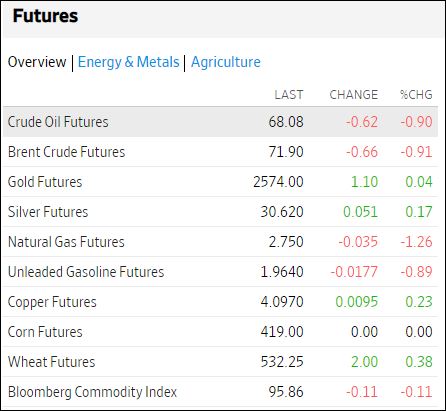
Oil and natural gas drilling, production, and refining. This sector will benefit from Trump’s “drill, baby, drill” policies including increased leasing on
Federal lands, increased offshore drilling, replenishment of the Strategic Petroleum Reserve, new pipelines, and expanded refinery capacity.
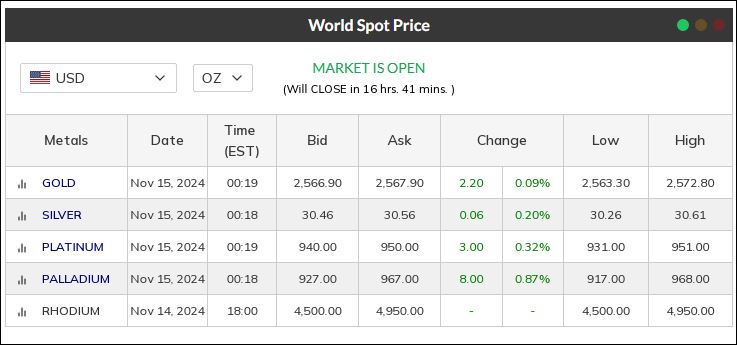
Mining (gold, silver, copper, lithium). Industrial metals will be in increased demand related to the expansion of U.S. manufacturing. Precious metals will
be in demand as a hedge against geopolitical uncertainty and as a non-digital store of wealth.
Defense and National Security. This will especially benefit defense and intelligence contractors with extensive R&D programs. The U.S. does not need more
obsolete weapons; we need newer and more sophisticated weapons to keep up with the high-tech systems that Russia is using. AI will be a valuable tool in
intelligence analysis, especially from open sources (OSINT).
Automobile manufacturing. Foreign manufacturers will face huge tariffs. This will include Mexican manufacturers that are fronts for China. The United
States-Mexico-Canada Agreement (USMCA) will be modified as needed to accommodate the tariffs.
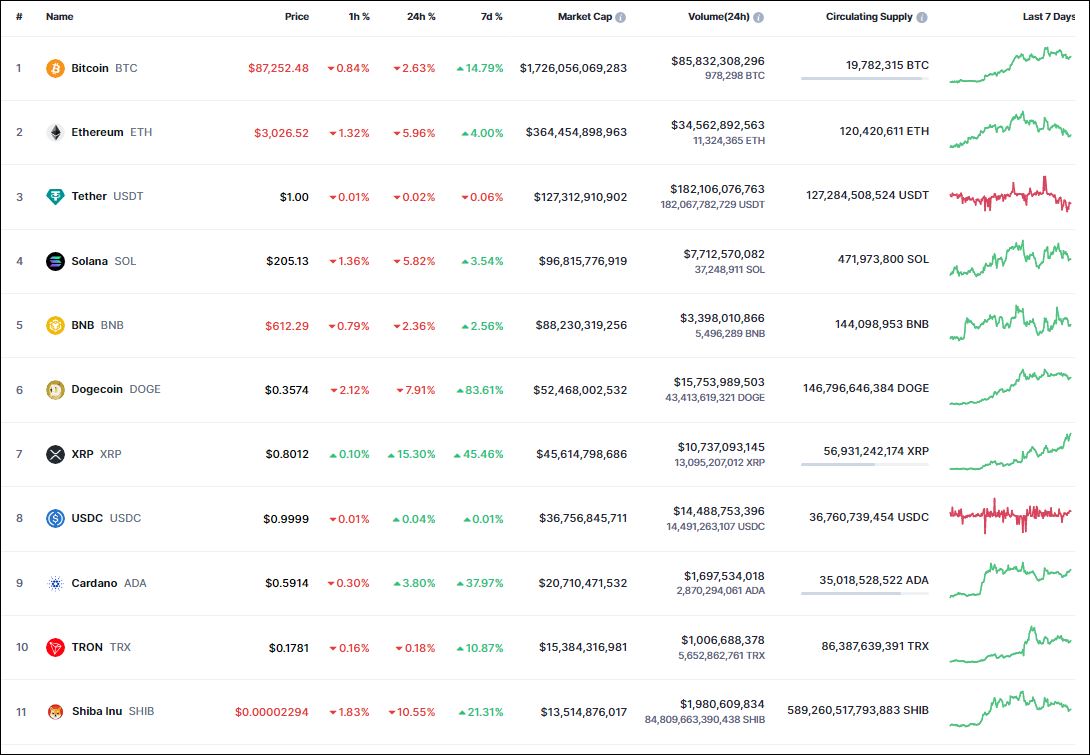
Cryptocurrency plays. Trump will ease SEC and other regulatory constraints on cryptocurrency mining, distribution and use.
Banking and finance. As the economy grows, banks profit as intermediaries without the need for high leverage and high risk.
Trucking and airlines. These sectors will benefit from lower prices for refined products such as diesel and aviation fuel (basically kerosene).
Sectors that will underperform in a new Trump administration will be Big Pharma and Big Agriculture under the motto of Make America Healthy Again.
Robert F. Kennedy, Jr. will lead this effort. Elon Musk will also lead an effort at government efficiency, which will hurt the profits of government
contractors in sectors such as health care, education, and the Green New Scam (including EVs, and windmill manufacturers). DEI initiatives will wither and
die. Portfolios that invest heavily in China or use ESG metrics will underperform.
Be sure to invest accordingly in the coming return of the American System, and rejoice as it brings prosperity back to U.S. citizens.
DOLLAR


CRYPTO

https://www.zerohedge.com/political/what-expect-trumps-first-day-office


Good call Martin!

Trump Wins, Eliminates Federal Income Tax, Economy Booms – Martin Armstrong
Legendary financial and geopolitical cycle analyst Martin Armstrong is back with some important predictions in his last appearance before the 2024 Election. First, Armstrong’s Socrates computer is still predicting a Trump landslide. Socrates actually factors in cheating to make this “Trump Wins” call. Armstrong says, “In the 2020 Election, it came out the computer said it was 50/50. It did not show a huge landslide one way or another. They rigged it, but it was in Congress is where they did it. . . . There were seven states that were going to be challenged. . . . On January 6 (during the so-called insurrection at the capitol), the FBI has testified they could not even tell how many people they had there. . . . as soon as this happens, Pelosi calls emergency rules. When she did the emergency rules, she shut down any challenge to the seven states. . . . That’s how the 2020 Election was really rigged. . . . in 2024, the gap is too big this time. In 2020, the computer said it was tight. This one, I don’t think they can cheat that much to actually overthrow it.”
If Trump does win, one of the huge changes going to be pushed is the elimination of federal income taxes. Let that sink in. When you hear Donald Trump say he is contemplating doing away with federal taxes, it is not some campaign promise that he intends to break. Armstrong says this is more than doable. When Trump says he can fix the economy, Armstrong contends eliminating federal income tax is a turbocharger for the American economy. Armstrong explains, “If you eliminate the income tax, what will happen is all these other companies that are in different countries are going to want to come here. It’s going to be the biggest economic boom in absolute history.”
Is this why Trump keeps saying he can “fix the economy”? Armstrong says, “Oh yes. The U.S. will make more money than you can ever imagine. When I testified in front of Congress, I said at least lower the tax rate to 15% on corporates. . . . 15% is what Hong Kong was charging, and that was the only reason people were there. . . . We do not need the income tax anymore because we create money anyway. We don’t need to get some money back like gold coins from the public so we can pay our bills. This is an old theory. So, income tax is something we do not need, and we certainly do not need to borrow anymore. Our national debt is exploding because of interest expenditures. . . . You eliminate the income tax, and you are going to have the biggest economic boom in absolute history. You will create so many jobs. You won’t have to worry about the debt. . . . We would get rid of the debt, and the equity would be private companies. If you wanted to create your own studio, there would be capital available to do that.”
Armstrong also talks about gold, who is really running the country and extreme civil unrest coming to America after the 2024 Election.
There is much more in the 54-minute interview.
https://tinyurl.com/37ftnauw
NEXT FOMC MEETING:
DEC 18


OPPORTUNITY TO ACCESS MARK LEIBOVIT’S PROPRIETARY VOLUME REVERSAL INDICATOR – THIS IS THE ONLY PLACE TO DO IT!
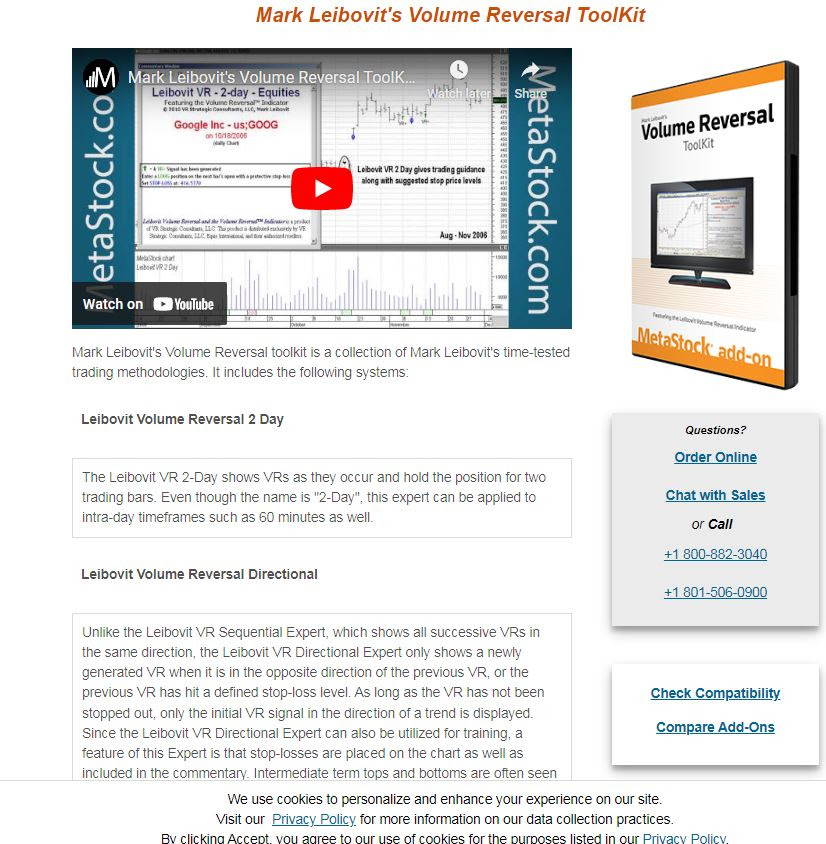
https://www.metastock.com/prod
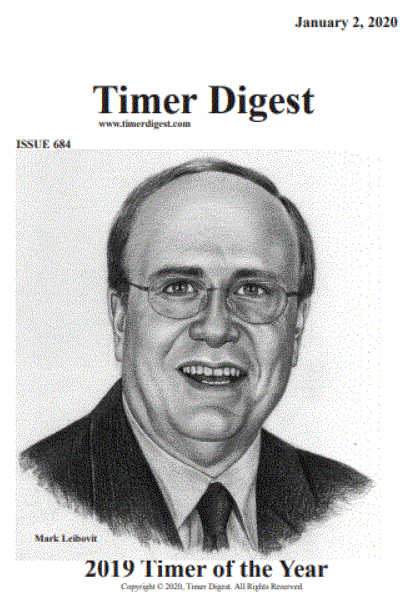

Yes, that’s a cartoon of me. Louis Rukeyser had us dressed up in ‘elf’ costumes on the screen broadcast each week. I’ve dated myself. That occurred for me between 1988-1996. Lou didn’t like any bearish comments, so myself and other elves got dumped in 1996.
WHO am I?
MARK LEIBOVIT is Chief Market Strategist for LEIBOVIT VR NEWSLETTERS a/k/a VRTrader.Com. His technical expertise is in overall market timing and stock selection based upon his proprietary VOLUME REVERSAL (TM) methodology and Annual Forecast Model.
Mark’s extensive media television profile includes seven years as a consultant ‘Elf’ on “Louis Rukeyser’s Wall Street Week” television program, and over thirty years as a Market Monitor guest for PBS “The Nightly Business Report”. He also has appeared on Fox Business News, CNBC, BNN (Canada), and Bloomberg, and has been interviewed in Barrons, Business Week, Forbes and The Wall Street Journal and Michael Campbell’s MoneyTalks.
In the January 2, 2020 edition of TIMER DIGEST MAGAZINE, Mark Leibovit was ranked the #1 U.S. Stock Market Timer and was previously ranked #1 Intermediate U.S. Market Timer for the ten year period December, 1997 to 2007.
He was a ‘Market Maker’ on the Chicago Board Options Exchange and the Midwest Options Exchange and then went on to work in the Research department of two Chicago based brokerage firms. Mr. Leibovit now publishes a series of newsletters at www.LeibovitVRNewsletters.com. He became a member of the Market Technicians Association in 1982.
Mr. Leibovit’s specialty is Volume Analysis and his proprietary Leibovit Volume Reversal Indicator is well known for forecasting accurate signals of trend direction and reversals in the equity, metals and futures markets. He has historical experience recognizing, bull and bear markets and signaling alerts prior to market crashes. His indicator is currently available on the Metastock platform.
His comprehensive study on Volume Analysis, The Trader’s Book of Volume published by McGraw-Hill is a definitive guide to volume trading. It is now also published in Chinese. Mark has appeared in speaking engagements and seminars in the U.S. and Canada.



FDA-Approved Doesn’t Mean Safe for Your Family

Grant Williams’ documentary examining gold price manipulation is posted at YouTube

An hour-long documentary program produced in 2018 by financial letter writer Grant Williams for his Real Vision internet site concentrates on gold price
manipulation and was posted Friday in the clear at YouTube.
The program is Part 2 of “Gold: The Story of Man’s 6,000 Year Obsession,” and it’s still compelling for incisive comments from some major figures in the
gold world, including Brent Cook, Dan Oliver, Egon von Greyerz, Jim Rickards, Luke Gromen, Ned Naylor-Leyland, Rick Rule, Ronald-Peter Stoeferle, Ross
Beaty, Ross Norman, Simon Mikhailovich, and Bernhard Schnellmann.
It can be seen at YouTube here:
https://tinyurl.com/k4vnpjmu

The Walt Disney Company has been criticized (MYSELF INCLUDED) for its “woke” content and has faced backlash from conservative politicians and social media voices. Some of the criticisms include:
-
Donations to LGBTQIA+ organizations
Some shareholders have argued that Disney’s donations to organizations that serve the LGBTQIA+ community are “extreme pursuits” that ignore the beliefs of most Americans.
-
Inclusion of LGBTQ+ characters
Some critics have taken issue with Disney’s inclusion of LGBTQ+ characters and elements in stories, such as a same-sex kiss in Lightyear and a nonbinary character in Elemental.
-
Black Ariel in Little Mermaid
Some critics have taken issue with the inclusion of a Black Ariel in the recent Little Mermaid.
-
Economic and reputational consequences
Some claim that Disney’s “woke virtue signaling” has had economic and reputational consequences, with Disney’s market cap falling nearly 40% since February 2021.
In response to these criticisms, Disney CEO Bob Iger has said that:
-
Disney’s biggest priority is entertaining audiences
-
Disney is focused on the future, not the past
-
Disney needs to be more sensitive to the interest of a broad audience
-
Disney’s primary mission is to entertain and then have a positive impact on the world through entertainment
I USE JOEL WALLACH’S SUPPLEMENTS EVERY DAY. MAY AGAIN PROVIDE A LINK TO PURCHASE THEM HERE


COME ON, DAD. IT’S TIME TO EAT

DISCLAIMER:
WE ARE NOT FINANCIAL ADVISORS AND DO NOT PROVIDE FINANCIAL ADVICE
The website, LeibovitVRNewsletters.com, is published by LeibovitVRNewsletters LLC.
In using LeibovitVRnewsletters.com (a/k/a LeibovitVRNewsletters LLC) you agree to these Terms & Conditions governing the use of the service. These Terms & Conditions are subject to change without notice. We are publishers and are not registered as a broker-dealer or investment adviser either with the U.S. Securities and Exchange Commission or with any state securities authority.
All stocks and ETFs discussed are HYPOTHETICAL and not actual trades whose actual execution may differ markedly from prices posted on the website and in emails. This may be due internet connectivity, quote delays, data entry errors and other market conditions. Hypothetical or simulated performance results have certain inherent limitations as to liquidity and execution among other variables. PAST RESULTS ARE NOT NECESSARILY INDICATIVE OF FUTURE FORECASTING ACCURACY OR PROFITABLE TRADING RESULTS.
All investments are subject to risk, which should be considered on an individual basis before making any investment decision. We are not responsible for errors and omissions. These publications are intended solely for information and educational purposes only and the content within is not to be construed, under any circumstances, as an offer to buy or to sell or a solicitation to buy or sell or trade in any commodities or securities named within.
All commentary is provided for educational purposes only. This material is based upon information we consider reliable. However, accuracy is not guaranteed. Subscribers should always do their own investigation before investing in any security. Furthermore, you cannot be assured that your will profit or that any losses can or will be limited. It is important to know that no guarantee of any kind is implied nor possible where projections of future conditions in the markets are attempted.
Stocks and ETFs may be held by principals of LeibovitVRNewsletters LLC whose personal investment decisions including entry and exit points may differ from guidelines posted.
LeibovitVRNewsletters.com cannot and do not assess, verify or guarantee the suitability or profitability of any particular investment. You bear responsibility for your own investment research and decisions and should seek the advice of a qualified securities professional before making any investment. As an express condition of using this service and anytime after ending the service, you agree not to hold LeibovitVRNewsletters.com or any employees liable for trading losses, lost profits or other damages resulting from your use of information on the Site in any form (Web-based, email-based, or downloadable software), and you agree to indemnify and hold LeibovitVRNewsletters.com and its employees harmless from and against any and all claims, losses, liabilities, costs, and expenses (including but not limited to attorneys’ fees) arising from your violation of this agreement. This paragraph is not intended to limit rights available to you or to us that may be available under the federal securities laws.
For rights, permissions, subscription and customer service, contact the publisher at mark.vrtrader@gmail.com or call at 928-282-1275 or mail to 10632 N. Scottsdale Road B-426, Scottsdale, AZ 85254.
The Leibovit Volume Reversal, Volume Reversal and Leibovit VR are registered trademarks.
© Copyright 2024. All rights reserved.


[/fusion_text][/fusion_builder_column][/fusion_builder_row][/fusion_builder_container]