
ilder_container type=”flex” hundred_percent=”no” equal_height_columns=”no” menu_anchor=”” hide_on_mobile=”small-visibility,medium-visibility,large-visibility” class=”” id=”” background_color=”” background_image=”” background_position=”center center” background_repeat=”no-repeat” fade=”no” background_parallax=”none” parallax_speed=”0.3″ video_mp4=”” video_webm=”” video_ogv=”” video_url=”” video_aspect_ratio=”16:9″ video_loop=”yes” video_mute=”yes” overlay_color=”” video_preview_image=”” border_color=”” border_style=”solid” padding_top=”” padding_bottom=”” padding_left=”” padding_right=””]


Watch out for this fellow:

GENERAL NEWS:
After an early move to the upside, stocks fluctuated over the course of the trading session on Friday before eventually ending the session narrowly mixed. The Nasdaq and the S&P 500 closed modestly higher, while the narrower Dow edged slightly lower.
While the Dow slipped 18.38 points or 0.1 percent to 37,385.97, the Nasdaq rose 29.11 points or 0.2 percent to 14,992.97 and the S&P 500 crept up 7.88 points or 0.2 percent to 4,754.63.
Despite the mixed performance on the day, the major averages all moved higher for the week. The Nasdaq jumped by 1.2 percent, the S&P 500 advanced by 0.8 percent and the Dow edged up by 0.2 percent.
Stocks initially benefited from the release of tamer-than-expected U.S. inflation data, but other upbeat economic data led to some uncertainty about the outlook for interest rates.
The Commerce Department released a highly anticipated report showing the annual rate of consumer price growth decelerated to 2.6 percent in November from a downwardly revised 2.9 percent in October.
Economists had expected the pace of price growth to slow to 2.8 percent from the 3.0 percent originally reported for the previous month.
The annual rate of growth by core consumer prices, which exclude food and energy prices, also slowed to 3.2 percent in November from a downwardly revised 3.4 percent in October.
Economists had expected core consumer price growth to decelerate to 3.3 percent from the 3.5 percent originally reported for the previous month.
The readings on inflation, which are said to be preferred by the Federal Reserve, were included in the Commerce Department’s report on personal income and spending.
The bigger than expected slowdown in consumer price growth added to optimism the Fed is poised to pivot to cutting interest rates early next year.
Meanwhile, the Commerce Department released a separate report showing new orders for U.S. manufactured durable goods surged by much more than expected in the month of November.
The report said durable goods orders spiked by 5.4 percent in November after tumbling by a revised 5.1 percent in October.
Economists had expected durable goods orders to jump by 2.2 percent compared to the 5.4 percent nosedive that had been reported for the previous month.
Excluding a rebound in orders for transportation equipment, durable goods orders climbed by 0.5 percent in November after falling by 0.3 percent in October. Ex-transportation orders were expected to inch up by 0.1 percent.
Alex McGrath, Chief Investment Officer for NorthEnd Private Wealth, noted core consumer price growth is still well above the Fed’s target of 2.0 percent, which he said is “less supportive of the imminent cuts the market is expecting.”
“This especially comes into focus looking at the durable goods orders that came in wildly above expectations,” McGrath said. “The idea that to drive inflation down the economy needs to slow has once again put the Fed in between a rock and a hard place.”
He added, “If the economy never slows down enough to fully stamp inflation out and they begin cutting, do we see an Arthur Burns 2.0 moment where the battle with inflation rears its head again in 2024? That will undoubtedly be one of the more pressing questions facing investors next year.”
A steep drop by shares of Nike (NKE) weighed on the Dow, with the athletic apparel and footwear giant plunging by 11.8 percent after the company lowered its revenue outlook and unveiled plans to cut $2 billion in costs over the next three years.
Sector News
Most of the major sectors ended the day showing only modest moves, contributing to the lackluster close by the broad markets.
Biotechnology stocks showed a significant move to the upside, however, with the NYSE Arca Biotechnology Index jumping by 2.0 percent to a five-month closing high.
Notable strength was also visible among airline stocks, as reflected by the 1.0 percent gain posted by the NYSE Arca Airline Index.
Other Markets
In overseas trading, stocks across the Asia-Pacific region turned in a lackluster performance during trading on Friday. Japan’s Nikkei 225 Index inched up by 0.1 percent, while China’s Shanghai Composite Index edged down by 0.1 percent.
The major European markets also ended the day little changed. While the French CAC 40 Index closed marginally lower, the U.K.’s FTSE 100 Index closed just above the unchanged line and the German DAX Index inched up by 0.1 percent.
In the bond market, treasuries closed roughly flat after pulling back off their early highs. Subsequently, the yield on the benchmark ten-year note, which moves opposite of its price, crept up by less than a basis point to 3.901 percent.
Looking Ahead
Next week’s trading activity may be somewhat subdued following the Christmas weekend, with a relatively light U.S. economic calendar also likely to keep some traders on the sidelines.
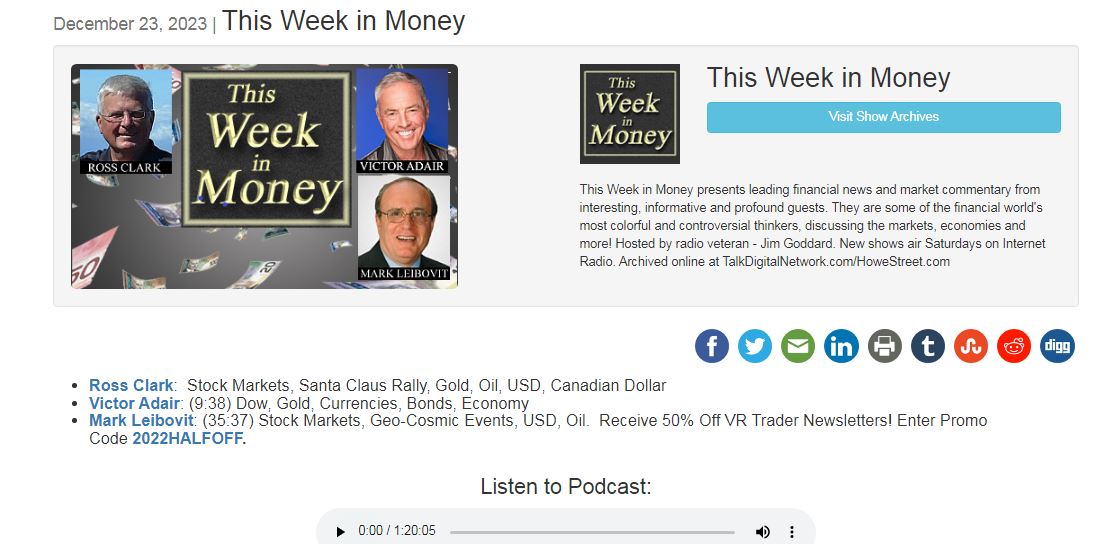
https://www.howestreet.com/2023/12/gold-oil-currencies-geocosmic-events-victor-adair-mark-leibovit-ross-clark-this-week-in-money/
\

https://abcnews.go.com/International/iceland-volcano-eruption-toxic-air-warning/story?id=105806785
BRICS: China & Saudi Arabia Drive Global End to US Dollar -Watcher.guru
No one knows for sure what the future holds; but if it’s the future of the US dollar, it’s probably not good. The “dedollarization” movement continues and 2024 could prove to be more than challenging for the greenback.
by Joshua Ramos
For much of the year, the BRICS bloc has seen a renewed focus on de-dollarization. Indeed, its 2023 annual summit ended with a five-nation expansion plan and several initiatives to help boost local currencies. Now, amid the expansion of the BRICS bloc, both China and Saudi Arabia are set to drive the global end to the US dollar.
Saudi Arabia was one of the five nations set to join the alliance. Specifically, it joined the United Arab Emirates (UAE), Egypt, Iran, and Ethiopia. However, the nation is poised to be of massive importance to the bloc’s efforts against the dollar. Subsequently, even a former US official has warned of what its cooperation with the initiatives could mean.
Throughout 2023, the BRICS alliance has shaken up the geopolitical sector. Indeed, the bloc has consistently challenged the status quo of the global order. Subsequently, they have driven their own goal of multipolarity in the current international landscape. Now, those two things could see continued evolution through the coming year, thanks to recent cooperation.
Specifically, the BRICS bloc is set to see both China and Saudi Arabia drive the global end to the US dollar. Indeed, the two nations have agreed to a landmark currency swap that will continue to push Saudi Arabia’s embrace of BRICS local currencies. Therefore, it will only decrease its use of the US dollar.
These Are the Bank Bailout Charts the Fed Hopes You’ll Never See in One Place -Wall Street on Parade
How healthy is your bank? The banking industry has faced many challenges this year to put it mildly. It is difficult to know whether or not our bank is safe because, more often than not, we don’t know until after the crisis hits.
by Pam Martens and Russ Martens
Jerome Powell became the Chairman of the Federal Reserve on February 5, 2018 after being nominated by then President Donald Trump and passing his Senate confirmation. Powell was sworn in again on May 23, 2022 for a second term as Chair. His second term runs until May 15, 2026.
Unlike most Fed Chairs, Powell has no economics degree. He has a law degree from Georgetown University. For more background on Powell, see our May 18, 2020 article: The Fed’s Chair and Vice Chair Got Rich at Carlyle Group, a Private Equity Fund with a String of Bankruptcies and Job Losses.
Powell’s tenure as Fed Chair has been mired by the biggest trading scandal in the Federal Reserve’s 110-year history. That scandal has yet to be resolved in a manner that meets the test of accountability. See our October report: After Two Years, There’s Still No Law Enforcement Report on Former Dallas Fed President Robert Kaplan’s Trading Like a Hedge Fund Kingpin.
But the biggest Fed scandal hiding in plain sight involves the trillions of dollars in bailout loans that the Fed has funneled to Wall Street trading houses during the tenure of Powell as Fed Chair.
U.S. Bank Fined $21M for Illegally Freezing Accounts -Newsbreak
Our modern day epidemic: banks arbitrarily freezing customers’ accounts. This economy is difficult enough to navigate already, but imagine trying to do so with no access to your money. Another reason to be as diversified as possible with your finances.
by Advocate Andy
One of America’s largest banks has been fined $21 million for illegal conduct.
The Consumer Financial Protection Bureau (CFPB) has assessed the penalty against U.S. Bank as a result of the bank’s unlawful activity during the COVID-19 pandemic.
Specifically, U.S. Bank froze customer accounts, preventing tens of thousands of customers from accessing unemployment benefits.
“At a time when unemployment was close to 15%, many out-of-work Americans throughout the country had little choice but to rely on U.S. Bank for their unemployment benefits. U.S. Bank blocked access to accounts and demanded burdensome paperwork in order for consumers to regain access to their frozen benefits,” said CFPB Director Rohit Chopra. “U.S. Bank must comply with the law, and the CFPB and OCC are making the bank pay for its conduct.”
US economist predicts 2024 will bring ‘biggest crash of our lifetime’ -Fox Business
By Kristen Altus
As the clock ticks closer to 2024, one outspoken economist is making a dire predication about the markets in the new year.
“Since 2009, this has been 100% artificial, unprecedented money printing and deficits; $27 trillion over 15 years, to be exact. This is off the charts, 100% artificial, which means we’re in a dangerous state,” Harry Dent told Fox News Digital. “I think 2024 is going to be the biggest single crash year we’ll see in our lifetimes.”
“I’m the guy that’s praying for a crash while everybody else is not. We need to get back down to normal, and we need to send a message to central banks,” he continued. “This should be a lesson I don’t think we’ll ever revisit. I don’t think we’ll ever see a bubble for any of our lifetimes again.”
Dent, who spent the majority of his career analyzing proprietary research, credited his against-the-grain prediction to overvalued markets and excessive stimulus spending. While recent rallies have overwhelmingly provided investors with mild recession expectations, Dent remained firm that an “everything bubble” will burst next year.
Historically, market bubbles are characterized by a rapid rise in stock prices, before being met by a sharp fall.
Gold is the solution to currency debasement – Richard Mills – Ahead of the Herd
Indeed, fiat currencies are being destroyed because of reckless money-printing by governments and this is the reason to own gold.
You don’t purchase gold to take advantage of short-term price fluctuations in the market, you buy it because it will always gain in value compared to paper money.
Over time, gold is a store of value because it is not subject to the inflationary pressures fiat currencies are. Since 1913, when the Federal Reserve was created, the US dollar has lost 96% of its value.
The extraordinary value of gold versus dollars is easily grasped by conducting a little thought experiment. Let’s say you were 18 years old in 1971, and just beginning your working life. In five years time you make some smart investments and manage to bank $100,000. At age 23 you have a decision to make: Is it better to plug that money into a retirement savings plan, or buy $100,000 worth of gold, which in 1976 is trading at $125/oz? You decide to buy gold.
Fast forward 47 years. You are now 70 years old and ready to retire. In 2023, gold is worth $2,000 an ounce — 16 times what you bought it for in 1976! The gold bars and coins just sat there in a safe, not earning interest. The 800 ounces you bought at $125/oz ($100,000) are now worth $1.6 million. This retirement nest egg would easily see you through to the ripe old age of 85, and that’s by withdrawing $106,000 a year. Live more modestly, and you could live to 100. Or leave a bunch of money to your kids, grandchildren, or charity.
The Fed is quietly signaling that stocks are overvalued and a recession is almost certain, top economist David Rosenberg says -Business Insider

Investors sent the Dow Jones Industrial Average to a record high on Wednesday after the Federal Reserve signaled that the inflation threat was fading and that it expected to cut interest rates three times in 2024. They may be celebrating too soon, David Rosenberg has warned.
The Fed chair, Jerome Powell, struck a positive tone after the central bank’s latest meeting. He pointed to the pace of price growth slowing markedly in recent months, unemployment hovering at historic lows, and economic output proving resilient.
Yet Rosenberg, a veteran economist who’s the president of Rosenberg Research, said in a pair of X posts on Wednesday that the Fed’s latest growth projection suggested stocks were overpriced and a recession was virtually guaranteed.


https://tinyurl.com/2rd9wv52
OPPORTUNITY TO ACCESS MARK LEIBOVIT’S PROPRIETARY VOLUME REVERSAL INDICATOR – THIS IS THE ONLY PLACE TO DO IT!
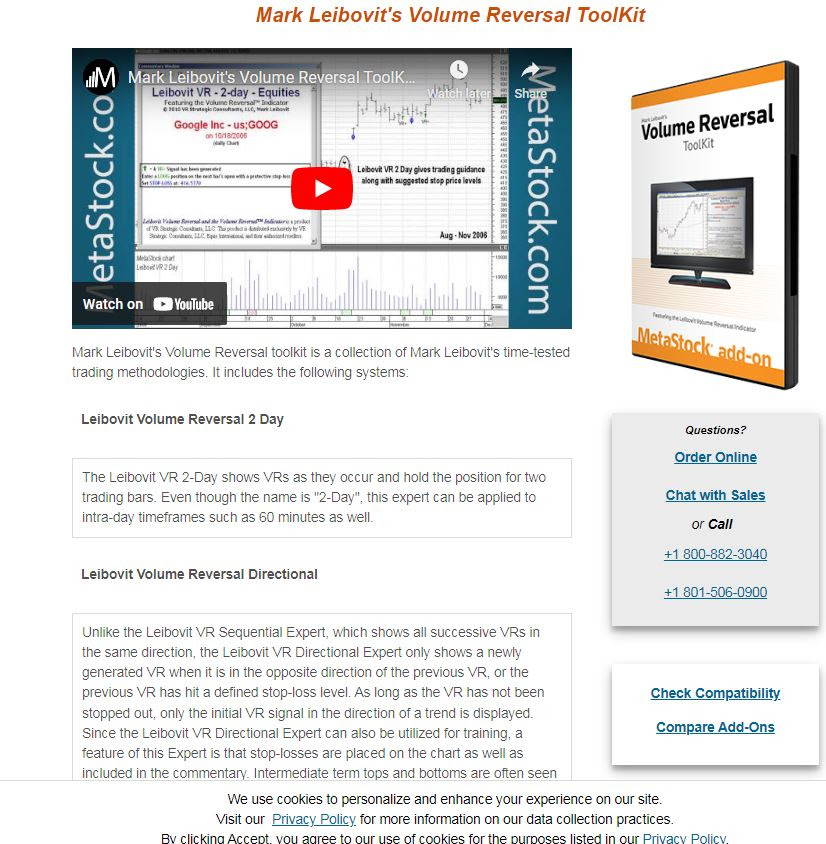
https://www.metastock.com/prod

COME ON, DAD. IT’S TIME TO EAT

DISCLAIMER:
WE ARE NOT FINANCIAL ADVISORS AND DO NOT PROVIDE FINANCIAL ADVICE
The website, LeibovitVRNewsletters.com, is published by LeibovitVRNewsletters LLC.
In using LeibovitVRnewsletters.com (a/k/a LeibovitVRNewsletters LLC) you agree to these Terms & Conditions governing the use of the service. These Terms & Conditions are subject to change without notice. We are publishers and are not registered as a broker-dealer or investment adviser either with the U.S. Securities and Exchange Commission or with any state securities authority.
All stocks and ETFs discussed are HYPOTHETICAL and not actual trades whose actual execution may differ markedly from prices posted on the website and in emails. This may be due internet connectivity, quote delays, data entry errors and other market conditions. Hypothetical or simulated performance results have certain inherent limitations as to liquidity and execution among other variables. PAST RESULTS ARE NOT NECESSARILY INDICATIVE OF FUTURE FORECASTING ACCURACY OR PROFITABLE TRADING RESULTS.
All investments are subject to risk, which should be considered on an individual basis before making any investment decision. We are not responsible for errors and omissions. These publications are intended solely for information and educational purposes only and the content within is not to be construed, under any circumstances, as an offer to buy or to sell or a solicitation to buy or sell or trade in any commodities or securities named within.
All commentary is provided for educational purposes only. This material is based upon information we consider reliable. However, accuracy is not guaranteed. Subscribers should always do their own investigation before investing in any security. Furthermore, you cannot be assured that your will profit or that any losses can or will be limited. It is important to know that no guarantee of any kind is implied nor possible where projections of future conditions in the markets are attempted.
Stocks and ETFs may be held by principals of LeibovitVRNewsletters LLC whose personal investment decisions including entry and exit points may differ from guidelines posted.
LeibovitVRNewsletters.com cannot and do not assess, verify or guarantee the suitability or profitability of any particular investment. You bear responsibility for your own investment research and decisions and should seek the advice of a qualified securities professional before making any investment. As an express condition of using this service and anytime after ending the service, you agree not to hold LeibovitVRNewsletters.com or any employees liable for trading losses, lost profits or other damages resulting from your use of information on the Site in any form (Web-based, email-based, or downloadable software), and you agree to indemnify and hold LeibovitVRNewsletters.com and its employees harmless from and against any and all claims, losses, liabilities, costs, and expenses (including but not limited to attorneys’ fees) arising from your violation of this agreement. This paragraph is not intended to limit rights available to you or to us that may be available under the federal securities laws.
For rights, permissions, subscription and customer service, contact the publisher at mark.vrtrader@gmail.com or call at 928-282-1275 or mail to 10632 N. Scottsdale Road B-426, Scottsdale, AZ 85254.
The Leibovit Volume Reversal, Volume Reversal and Leibovit VR are registered trademarks.
© Copyright 2023. All rights reserved.

